
Time-Saving Home Systems
10 Tiny Home Systems That Stop Everyday Mess From Piling Up
If you keep tidying the same little piles, searching for the same everyday things and discovering that something ran out only when you needed it, you may not need a bigger cleaning routine. You may just need a few smaller decisions to stop repeating themselves.
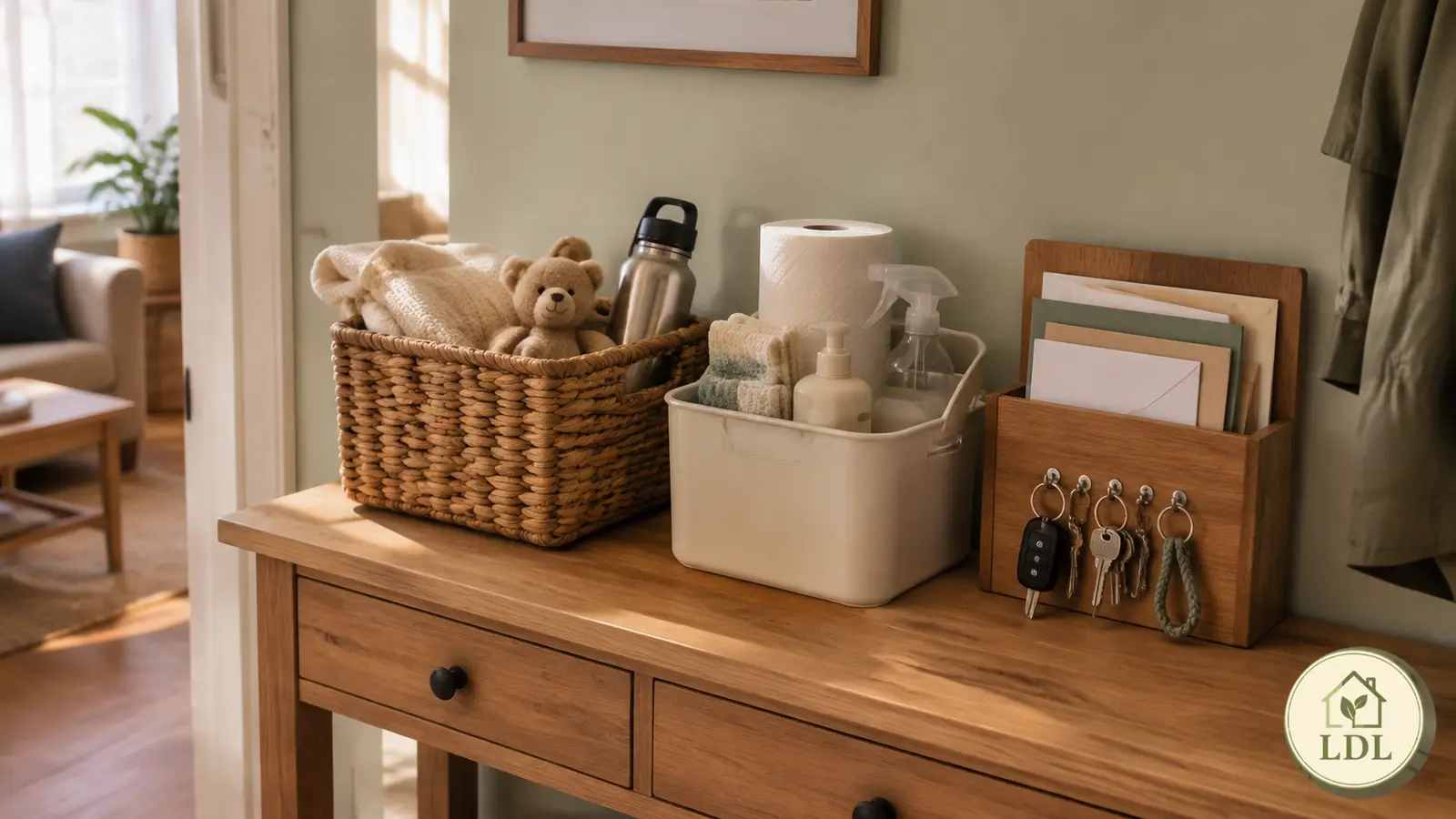
Some household messes are not really big messes. They are dozens of tiny unfinished decisions. The scissors move from room to room. The reusable bags disappear until grocery day. The last roll of something gets used and nobody notices. A form lands on the counter “for now.” A drawer slowly fills with batteries, tape, chargers and things that technically have homes—but not homes easy enough to use.
None of these problems feels serious on its own. That is exactly why they are so tiring. They keep asking for a little bit of attention, over and over, usually when you are already doing something else.
A useful home system removes one of those repeated decisions. It answers a small question in advance: Where does this go? When do we refill it? What happens when I do not have time to put it away properly? Which version do we use first?
You do not need all ten systems below. In fact, trying to install ten new routines in one weekend would defeat the point. Pick the problem that keeps irritating you most and make that one easier first.
1. Give the things you search for one landing place
Keys on the kitchen counter. Wallet in yesterday's bag. Sunglasses in the bedroom. A library card that somehow travels between three drawers.
When an item leaves the house often, the most useful home is not necessarily the prettiest storage spot. It is the place you naturally pass when you come in and leave again.
Choose one small landing place for the items that repeatedly trigger a search. It can be:
- a shallow tray;
- one hook;
- one bowl on a shelf;
- one pocket inside the everyday bag;
- one small drawer near the door.
The rule matters more than the container: the item returns there every time it enters the house.
If your entryway is where this problem keeps happening, our entryway drop-zone guide builds the same idea around shoes, bags and keys without requiring a mudroom.
2. Keep one temporary return basket for things that belong somewhere else
You are resetting the living room and find a sock, a toy, a hairbrush, a mug and a charging cable. Walking each object back immediately can turn a five-minute reset into a tour of the entire house.
Use one small basket as a temporary return station. During a quick reset, place out-of-room items there. When you are already heading toward the rooms they belong in, take them with you.
The important part is the limit: one basket, emptied regularly.
Do not create a permanent “miscellaneous” bin for every room. If the basket is still full a week later, it is no longer saving steps; it is hiding decisions.
This works especially well with the 10-Minute Home Reset, where the goal is to restore function without getting pulled into side tasks.
3. Separate everyday supplies from backups
One bottle is in use. Three backups are squeezed behind it. Then a new multipack arrives and gets placed wherever there is room. A few months later, you are sure you have more shampoo, toothpaste, snacks or cleaning cloths somewhere—you just cannot remember where.
Give backups one defined home away from the premium everyday-access space.
For example:
- one bathroom shelf for unopened toiletries;
- one pantry bin for extra snack packs;
- one cabinet area for cleaning refills;
- one closet basket for spare household consumables.
Then keep only the active item where it is actually used. This makes the daily area easier to reset and makes the backup supply visible enough to count.
If visibility is the problem, the SKTEET clear storage-bin set is one optional example. The set includes four large and four small open PET bins with handles, so it can work for broad backup categories where seeing the contents matters.
Think twice before buying it: the set has eight bins, no lids, and the dimensions captured from the listing are not clearly assigned to each size. Try one existing basket first. If a visible backup zone actually helps you stop overbuying or searching, then measure the shelf before choosing a permanent bin.
Read our guide to the SKTEET clear storage-bin set →
4. Create a refill trigger instead of relying on memory
Running out is rarely dramatic until it happens at the exact wrong moment. The last trash bag disappears. The toothpaste is squeezed flat. The coffee runs out on a morning when nobody wants another problem.
Instead of asking yourself to remember every household supply, choose a simple refill trigger.
Examples:
- when the final unopened backup moves into use, add the item to the shopping list;
- when a pantry category reaches one remaining package, restock it;
- keep one spare of the essentials you truly dislike running out of—and no more than the storage boundary allows;
- place a small “buy next” note where the backup supply lives.
The exact number does not matter. The system works because the trigger happens before the item is completely gone.
Do not create backup rules for everything. Some items are easy to replace and not worth storing in multiples. Save this system for the things that repeatedly cause inconvenience when they run out.
5. Make an “open first” zone for duplicates
Two cereal boxes are open. Three half-used sauces are hiding in the fridge door. A second pack gets opened because nobody saw the first one. Then the oldest item is discovered after it is no longer useful.
Choose one small area for products that should be finished first.
In a pantry, it might be one basket or front section of a shelf. In the refrigerator, it might be one visible “use first” spot. The purpose is not to create another complicated label category. It is to make the partly used or older item harder to overlook.
This is particularly useful after grocery day, when new packages naturally want to take the easiest positions.
If your shelves are already crowded enough that nothing stays visible, start with our small-pantry organization guide. Visibility has to exist before an “open first” rule can work.
6. Divide the one drawer that catches everything
Most homes have at least one drawer that quietly becomes the answer to “Where should I put this?” Tape, pens, batteries, clips, small tools, spare keys, charging cables and the tiny object you are afraid to throw away all end up competing for the same space.
The fix is not necessarily more tiny compartments. Start with three or four broad zones that match what actually lands there.
For example:
- writing and paper;
- small household tools;
- batteries and charging items;
- temporary items that need a decision.
If the drawer is large enough but categories constantly slide into each other, expandable dividers can help preserve those broad zones. The SpaceAid bamboo drawer dividers are one documented option; the selected version expands from roughly 17 to 22 inches and stands about 2.35 inches high.
Think twice if: your drawer is shorter than the expansion range, shallower than the divider height, or already too full to function. Dividers can organize available space; they cannot create capacity that is not there.
If you are not sure whether broad dividers or a compartment tray would suit the drawer better, use our drawer organizer tray vs dividers comparison before buying anything.
Read our guide to the SpaceAid drawer dividers →
7. Turn deep storage into reach-first storage
Deep cabinets look generous until the thing you need is behind four other things. Then the back half becomes storage you technically own but rarely use.
Before buying anything, try grouping a deep shelf by use. Put baking items together. Put sauces together. Put the medicines or toiletries you reach for together. Keep taller items from blocking shorter ones.
For small bottles and jars, a turntable can solve a very specific problem: the back of the shelf is difficult to reach.
The LAMU three-pack Lazy Susan set includes approximately 9.25-, 10.6- and 12-inch clear turntables.
Think twice before buying: measure shelf depth and door clearance, especially for the 12-inch size. Tall or top-heavy bottles can still tip if a turntable is spun quickly. If your real problem is simply too many items, rotating them will not fix the volume.
Read our guide to the LAMU Lazy Susan set →
8. Give tomorrow-specific items a temporary staging spot
Library books. A return that needs to go back to the store. A form that must leave in the morning. A package for the post office. Something for a child's activity that is not part of the normal everyday bag.
These things are awkward because they do not need a permanent home near the door—but they do need to leave soon.
Create one temporary “leaving next” spot. It can be a hook, shelf edge, basket or designated section of the entryway. Use it only for things that have a near-term exit.
Then empty it when the items leave. If it becomes permanent storage, it loses the signal that makes it useful.
This is different from the everyday landing place in system #1. One is for things that come and go constantly. The other is for unusual items that need help making it out of the house once.
Related: Rushed Mornings? 7 Things to Prep the Night Before →
9. Give growing categories a physical limit
Reusable bags multiply. Water bottles take over a shelf. Kids' craft supplies expand into a second drawer. Cleaning sprays appear in three rooms. The category grows because the house never tells it when to stop.
Give the category a boundary:
- one shelf;
- one basket;
- one drawer;
- one hook rail;
- one row in the cabinet.
When the boundary is full, the next step is not automatically a bigger organizer. First decide whether everything inside still earns the space.
This is especially helpful in small homes because storage expansion can quietly make the room harder to use. Our small-space storage guide explains when adding vertical or hidden storage is genuinely useful—and when the category itself needs editing.
10. Attach one tiny reset to something you already do
A household system is much easier to maintain when it does not need its own special time slot.
Attach one small reset to an action that already happens:
- after dinner, return the kitchen's most-used tools;
- when the children go to bed, clear the main walking path;
- after unpacking groceries, move older food to the “open first” area;
- when you put your keys down, place tomorrow-specific items beside the departure zone;
- when the final backup enters use, add it to the shopping list.
Keep the reset small enough that it still happens on an ordinary tired day. A two-minute system repeated often can be more useful than an elaborate weekly routine that keeps getting postponed.
The goal is not to make every household action automatic. It is to remove a few of the repeat problems that keep stealing attention for no good reason.
How to choose the first system to fix
If all ten ideas sound useful, do not start all ten.
For the next three days, notice the sentence you keep saying:
- “Where is the…?”
- “We ran out again.”
- “Why is this always on the counter?”
- “I know we bought more somewhere.”
- “I keep putting this away and it comes right back.”
That sentence is probably pointing to the first system worth building.
If you keep searching, create a landing place. If you keep running out, create a refill trigger. If you keep overbuying, separate backups. If the same pile keeps returning, shorten the return path or give the category a clearer boundary.
The lighter-home rule
Stop making yourself solve the same small problem every day
Give high-frequency items one obvious landing place.
Use one temporary return basket instead of interrupting every quick reset.
Separate active supplies from backups and create a refill trigger.
Use boundaries to stop categories from quietly expanding.
Attach tiny resets to routines that already happen.
A calmer home is not necessarily one with more containers. Often it is a home where fewer small questions have to be answered again and again.
FAQ
Common questions about simple household systems
What is a simple home system?
A simple home system is a repeatable rule or setup that removes a recurring household decision. Examples include one place for keys, one backup-supply zone, a refill trigger, a return basket or a defined limit for a category that tends to spread.
How many home systems should I set up at once?
Usually one is enough to start. Choose the problem that repeats most often, use the new system for several days and adjust it before adding another. Installing too many rules at once can create more maintenance instead of less.
Do I need matching organizers to make a home system work?
No. Try the rule first with containers, trays, baskets or drawers you already own. Buy an organizer only after the system has shown you a specific fit, visibility or access problem that your existing storage cannot solve.
What if my family does not put things back in the new place?
Check the friction before adding reminders. The home may be too far from where the item is used, difficult to open, overly specific or already too full. A shorter and more obvious return path is often easier to maintain than a more detailed rule.
How do I stop buying duplicates of things I already have?
Keep backups together in one visible zone and separate them from active supplies. When you can see the full backup inventory in one place, it is easier to check what you own before adding another item to the shopping list.
Your turn
Which repeated household task needs a simpler system?
Tell us which small problem keeps costing time because the rule, storage place or refill trigger is unclear.
Comments are reviewed before anything is published. Your response will not appear publicly automatically.
Continue
Build the systems around the places that keep getting stuck
A note on this guide: This guide offers general household organization ideas and should be adapted to your home, family and available storage. Lighter Day Living has not personally tested the products mentioned here. Product dimensions and listing details come from Amazon listing information reviewed for this guide on August 10, 2026. Product links in this article open Lighter Day Living product guides rather than Amazon directly. Each guide contains clearly labeled Amazon affiliate links. You do not need to buy new organizers to use these systems; existing baskets, trays, drawers and shelves should be tried first when they can solve the same problem.