
Decision guide
Drawer Organizer Tray vs Dividers: Which Keeps Drawers Tidy?
If your drawer looks organized the day you fix it and chaotic again a week later, the problem may not be your effort. The organizer may simply be asking the drawer to behave in a way that does not match what you actually keep there.
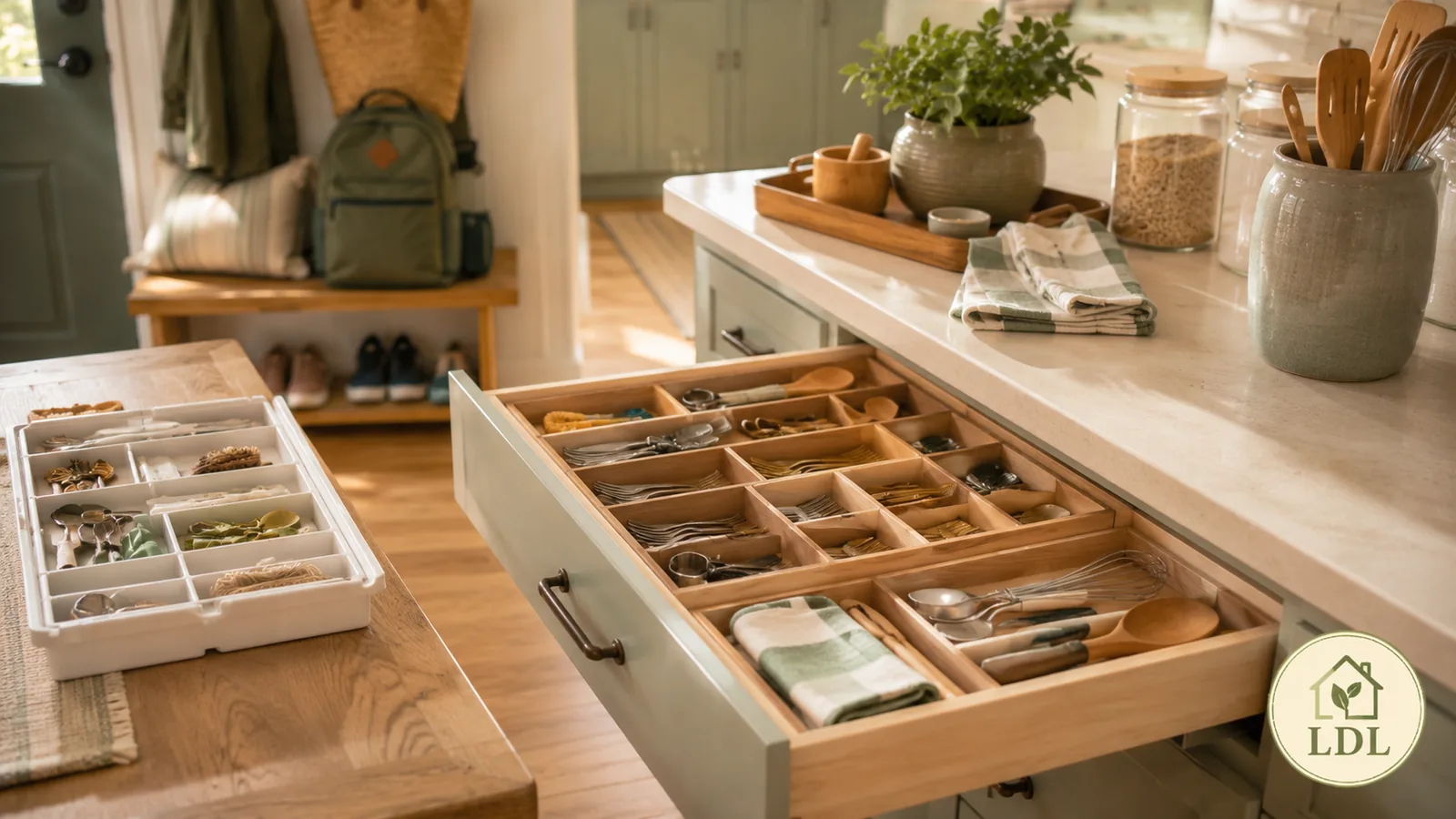
There is a particular kind of annoyance that comes from opening a drawer you organized recently and finding it mixed again. The forks have wandered into the spoon section. The peeler is lying diagonally across everything. A packet of clips has somehow become part of the utensil drawer. You push things back into place, close the drawer, and know you will probably repeat the same little argument tomorrow.
That is why the choice between a drawer organizer tray and adjustable dividers is not really about which one looks neater in a product photo. It is about what kind of movement happens inside your drawer after you start using it.
A tray gives small items fixed homes. Dividers create larger zones and let you decide how wide those zones should be. Both can work well. Both can also become expensive clutter if the drawer is overfilled, poorly measured or full of items that should not be there in the first place.
The short version: tray or dividers?
Choose a drawer tray for predictable categories.
Forks, spoons, knives, small cooking tools and other repeated categories benefit from fixed compartments that make the correct home obvious.
Choose adjustable dividers for mixed or awkward items.
Long utensils, kitchen tools, office supplies, clothing or catch-all categories often fit better when you can decide the width of each zone yourself.
Choose neither if the drawer is simply too full.
If every compartment would still be packed tightly, reduce or relocate the contents first. More structure will not fix too much volume.
First, notice what keeps going wrong in the drawer
Do not start by asking, “Which organizer should I buy?” Start by opening the drawer three or four times during an ordinary day and noticing the failure.
- Small items mix together? Fixed compartments may help.
- Large utensils slide across the whole drawer? Dividers may help.
- Things do not physically fit into the existing sections? The layout is wrong for the contents.
- The drawer catches when you open it? The drawer may simply contain too much.
- People keep putting things in the “wrong” place? The system may be too detailed or unintuitive.
That last one matters. A drawer with twelve tiny categories can look beautifully organized when one person maintains it, but if everyone else has to stop and think about where a measuring spoon, clip or small spatula belongs, the system may slowly collapse into one mixed compartment anyway.
At a glance
What each system actually changes
Organizer trayCreates ready-made compartments; strongest when item categories are consistent and relatively small.
Adjustable dividersCreates custom zones inside the drawer; strongest when item sizes or categories are mixed and may change.
No organizerCan still work when the drawer contains only a few items and each is easy to see and retrieve.
Option 1: an organizer tray when you want obvious homes
A tray is useful when you do not want to make a decision every time you put something away. Forks go here. Spoons go there. Small knives go in another section. The walls of the tray do the remembering for you.
The Pipishell Bamboo Expandable Silverware Drawer Organizer included in this guide expands from about 13 to 19.6 inches wide and provides six to eight compartments depending on how far it is opened. The retailer listing advises checking for a drawer around 14 × 18 inches or larger for the selected fit.
The useful part of an expandable tray is that it gives you the clarity of fixed compartments without requiring every drawer to be exactly the same width. If the drawer is wide enough, expanding the side sections can create additional room for cooking utensils or small tools.
But a tray makes a decision for you: this is how the drawer will be divided. That is convenient when the categories match the layout and frustrating when they do not.
A long whisk may ignore the compartment boundaries. A bulky can opener may consume half a section. Large serving spoons may stack on top of one another while an adjacent flatware slot sits half empty. The organizer can technically fit the drawer while still wasting usable space.
Think twice if: your drawer contains mostly large or irregular tools, your categories change often, or the drawer is smaller than the organizer's documented fit range.
Read our guide to the Pipishell expandable drawer organizer →
Option 2: adjustable dividers when the drawer needs flexible zones
Dividers work differently. Instead of inserting a complete tray, you use the drawer itself as the container and add boundaries only where you need them.
That can be especially useful in a utensil drawer where one zone needs to hold long spatulas, another needs to hold tongs, and another needs to hold smaller tools. It can also work in dresser, office or utility drawers where the categories are too large or inconsistent for a conventional flatware tray.
The SpaceAid Bamboo Drawer Dividers with Inserts and Labels uses spring-loaded expandable dividers. The selected version expands from about 17 to 22 inches long, stands about 2.35 inches high and includes four main dividers, nine removable inserts and label stickers according to the listing information we recorded.
The removable inserts are important because dividers do not have to mean only four giant sections. You can create a wide zone for cooking tools and then subdivide one smaller area for clips, measuring spoons or other little pieces.
The tradeoff is that the system depends on the drawer itself. The expansion range has to match the exact internal dimension where the divider will sit. The walls need to tolerate the spring-loaded fit. And the drawer needs enough height to close comfortably above a 2.35-inch divider.
Think twice if: the drawer is shorter than the selected expansion range, very shallow, has delicate side walls, or contains lots of tiny items that would still migrate inside broad zones.
Read our guide to the SpaceAid drawer dividers →
Which one is better for a silverware drawer?
For ordinary forks, spoons, table knives and a few small utensils, a tray usually makes more sense. The categories are predictable, the items are similar in size, and everyone can see where each group belongs.
The biggest advantage is not appearance. It is speed. You can unload the dishwasher without deciding where to put every piece.
Dividers can still work for silverware, especially in a large drawer, but broad zones may let small pieces slide together unless you add enough inserts. If you find yourself recreating all the little sections of a tray with multiple dividers and mini inserts, a tray may be the simpler tool.
Which one is better for a cooking-utensil drawer?
This is where dividers often become more useful.
Cooking tools rarely behave like flatware. Tongs are long. Peelers are small. Whisks are bulky. Measuring spoons get tangled. A pizza cutter has a shape that seems designed to waste drawer space. Trying to force all of those objects into six neat tray compartments can create more stacking than organization.
With dividers, you can create wider lanes based on the size and use of the tools:
- everyday stirring and flipping tools;
- measuring and prep tools;
- small gadgets;
- less-frequent specialty items.
But if you own only eight or ten cooking tools and they already lie flat without tangling, you may not need either system. Sometimes the best “organizer” is simply removing the fifteen tools you never reach for.
Which system wastes less drawer space?
There is no universal winner because the answer depends on the shape of your drawer and the shape of your things.
A tray has its own outer walls and preset compartment walls. That structure can leave small gaps around the organizer or create sections that are wider or narrower than you need. An expandable tray reduces some of that waste because it can use more of the drawer width, but it still imposes its own layout.
Dividers use more of the drawer itself as usable storage. There is no full organizer shell occupying the floor. You can position each divider according to the categories you actually own.
However, “more usable area” is not automatically “more organized.” If one large divided zone becomes a pile of twelve little objects, you gained capacity but lost clarity. The most efficient organizer is the one that creates enough structure to stop the repeated mess without dividing the drawer into more sections than you can maintain.
Which one stays organized longer?
The one whose categories are obvious enough that you can put things away without thinking.
That sounds almost too simple, but it is the part that determines whether the drawer still works a month later.
A tray can stay tidy for years when the categories are stable. Flatware does not suddenly change shape. The sections remain obvious.
Dividers can stay tidy when the drawer contents are larger and the zones are broad: cooking tools here, measuring tools there, clips in one smaller insert. They are also easier to reconfigure when your needs change.
Both systems fail when the category volume keeps growing. If the “small gadgets” section becomes full, the next gadget will spill into another section. At that point, the problem is no longer the divider. The category has exceeded the space you gave it.
What about a junk drawer?
A catch-all drawer is often better served by dividers than by a traditional silverware tray because the categories are mixed and may change over time.
But do not create a tiny compartment for every mysterious object. Start with three or four broad zones:
- writing and paper items;
- batteries and charging accessories;
- small household tools;
- temporary things that still need a decision.
If one category genuinely contains small pieces, use a mini insert or a small container inside that zone. The goal is to make cleanup obvious, not turn the drawer into a puzzle.
Our Tiny Home Systems guide goes deeper into this kind of recurring catch-all clutter and why a broad, boring system often survives better than a very detailed one.
Measure the inside of the drawer—not the cabinet
This is where many perfectly good organizers become bad purchases.
Measure:
- internal width;
- internal depth;
- usable height with the drawer closed;
- the longest or widest objects you actually need to store.
For the Pipishell tray example, the recorded width expands from about 13 to 19.6 inches, and the listing image advises checking for a minimum drawer size of roughly 14 × 18 inches. For the SpaceAid divider example, the selected dividers expand from about 17 to 22 inches and stand about 2.35 inches high.
Those products solve different fit problems, so comparing the numbers directly is less useful than comparing each number with your drawer.
Try this 15-minute drawer test before buying anything
You can usually tell which system you need before ordering one.
- Empty the drawer completely. Put everything on the counter or table.
- Remove the obvious outsiders. If something has not been used in months, ask whether it deserves premium drawer space.
- Group the remaining items by natural category. Do not force categories just because they sound organized.
- Look at the shape of each group. Small and predictable points toward a tray; large and mixed points toward dividers.
- Use temporary boundaries. Small boxes, strips of cardboard or existing trays can simulate compartments for a few days.
- Notice what crosses the boundaries. That tells you where the eventual organizer needs more or less structure.
If the temporary system works, measure it. You now know what you are buying for instead of hoping an organizer will somehow create order by itself.
What if two people organize the same drawer differently?
This sounds trivial until one person keeps putting the scissors in “household tools” and another keeps putting them in “office supplies.” Then the organizer becomes a daily argument nobody needed.
When more than one person uses the drawer, choose categories that are obvious at a glance. “Forks” works. “Frequently used miscellaneous food-prep tools” probably does not.
This is another reason a tray is strong for highly predictable categories and dividers are strong for broad zones. The system should reduce decisions for everyone who uses it.
So, drawer tray or dividers—which is better?
Choose a tray when the drawer holds smaller, predictable categories and you want every group to have an obvious fixed home.
Choose dividers when the drawer holds larger, mixed or changing categories and you need to control the size of the zones yourself.
Choose neither yet when the drawer is too full, because adding compartments to an overfilled drawer usually creates a more organized-looking version of the same capacity problem.
If you are still unsure, finish this sentence: “My drawer annoys me because ______.” If the answer is “all the little things mix together,” start with a tray. If it is “the big things slide everywhere and no fixed tray fits them,” start with dividers. If it is “there is simply too much in here,” start by removing things.
Decision shortcut
Choose the system that matches the movement
“Forks, spoons and knives keep mixing.” A compartment tray is usually the clearer solution.
“My spatulas, tongs and gadgets all slide into one pile.” Adjustable dividers give larger tools flexible lanes.
“The drawer contents change often.” Dividers are easier to reconfigure.
“I want the fastest possible put-away system.” Use the fewest, most obvious categories that still prevent mixing.
“Nothing fits because the drawer is packed.” Declutter or relocate first. Do not buy an organizer to solve a capacity problem.
FAQ
Common questions about drawer trays and dividers
Are drawer dividers better than trays?
They are better for some drawers, not all. Dividers are more flexible for large, mixed or changing items. Trays are usually easier for predictable small categories such as everyday flatware because the compartments are already defined.
What is better for a kitchen utensil drawer?
Adjustable dividers often work better for long or irregular cooking tools because you can create wider sections. If your utensil drawer contains mostly small, predictable pieces, an expandable tray can still work well.
How do I keep drawer organizers from becoming messy again?
Keep the categories broad and obvious, leave some empty space in each section, and remove items when a category outgrows its zone. An organizer cannot stay tidy if every compartment is packed to its limit.
Should I use dividers in a junk drawer?
They can work well if you create only a few broad zones. Use smaller inserts or containers only for genuinely tiny items. Too many detailed categories can make a catch-all drawer harder to maintain, not easier.
What should I measure before buying a drawer organizer?
Measure the exact internal width, depth and usable height of the drawer, plus the size of the longest or widest items you need to store. Compare those measurements with the selected organizer or divider range before ordering.
Your turn
What keeps your drawer from staying organized?
Tell us how the drawer dimensions, item sizes or changing categories affect your choice.
Comments are reviewed before anything is published. Your response will not appear publicly automatically.
Continue
Fix the drawer without creating another organizing project
A note on this guide: Lighter Day Living has not personally tested the products discussed in this comparison. Product dimensions, materials, included pieces, expansion ranges and installation details come from Amazon listing information reviewed for this guide on August 10, 2026. Product links in this article open Lighter Day Living product guides rather than Amazon directly. Each guide contains clearly labeled Amazon affiliate links. Measure the exact inside dimensions of your drawer and review the current retailer listing before purchasing.