
Kitchen Organization
How to Organize a Small Kitchen When You're Out of Space
When every drawer feels too full and the counter disappears the moment you start cooking, the answer is not always more storage. Often, it is making the storage you already have easier to reach, easier to see and easier to put back.
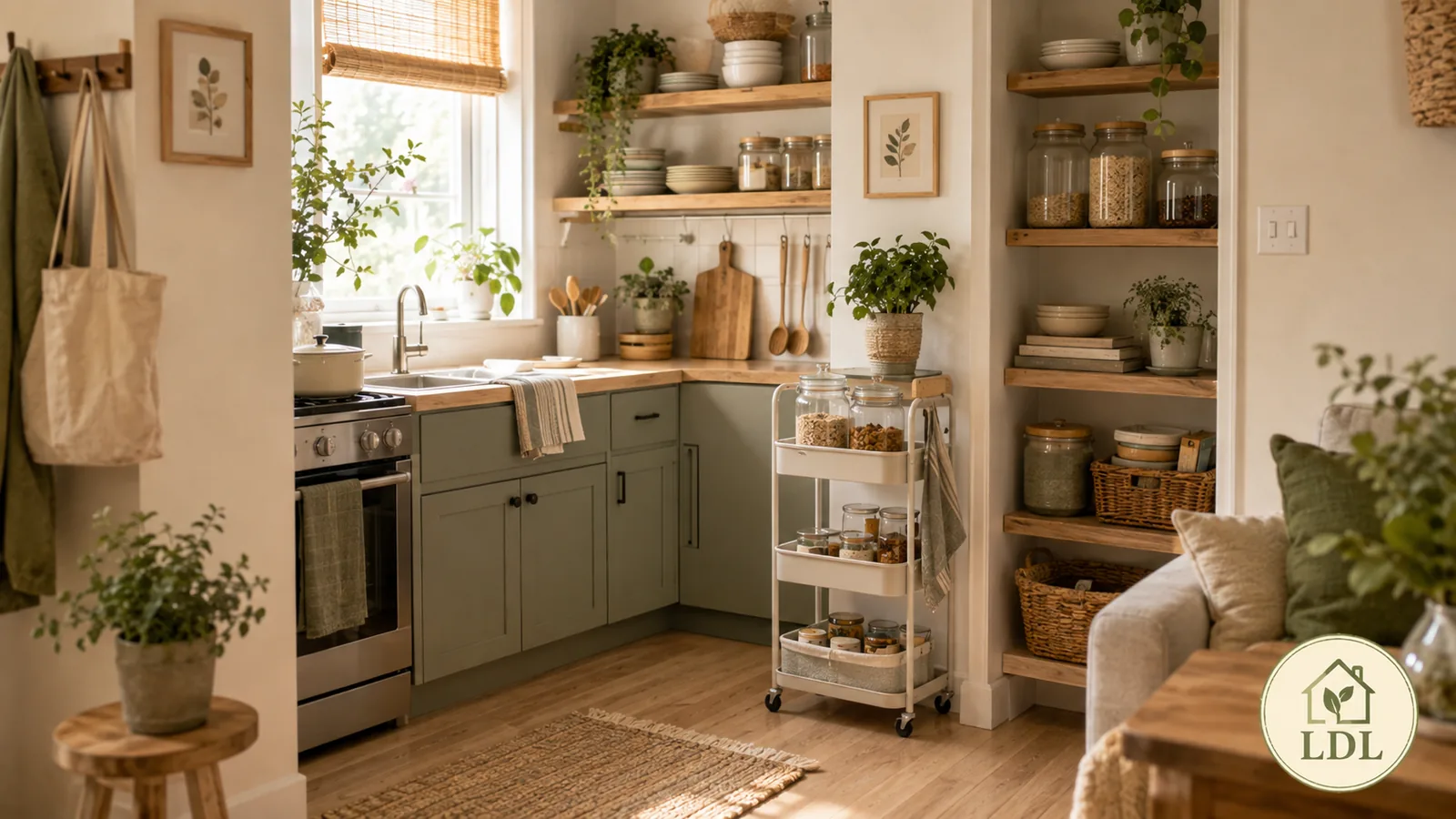
A small kitchen can make you feel as if the room is arguing with you. You open one drawer and the peeler catches on the whisk. You pull out a frying pan and two lids slide forward with it. You come home with groceries and realize the only clear patch of counter is already holding the toaster, oil bottles and yesterday's mail. None of these things is a crisis. Together, though, they make ordinary cooking feel strangely tiring.
That is the part of small-kitchen organization that pretty photos often miss. The frustration is not simply that the room is small. It is that the same few easy-to-reach inches are being asked to do too many jobs. When every useful surface is crowded, you spend your time moving things before you can use things.
The goal here is not to make your kitchen look empty. It is to make it stop fighting you. We will start with free changes, then look at organizers only where they solve a repeated problem.
1. Find the three places where your kitchen slows you down
Do not begin by emptying every cabinet onto the floor. That can turn a manageable problem into a three-hour project you did not have energy for in the first place.
Instead, notice the kitchen during one ordinary day. Where do you hesitate? What do you move out of the way? What falls over? What do you repeatedly search for?
For many small kitchens, the friction shows up in a few familiar places:
- the main prep counter is never quite clear;
- everyday utensils are mixed with rarely used tools;
- short dishes sit on tall cabinet shelves with empty space above them;
- pans and lids are stacked so tightly that taking one means moving four;
- the under-sink cabinet has plenty of volume but almost no usable structure.
Pick the worst three. You do not have to organize the whole kitchen to feel a difference.
2. Protect one patch of counter as a working surface
When a kitchen is small, counter space is not decoration space. It is working space. If every inch already has a permanent resident, chopping one onion can require a round of relocation first.
Choose one section of counter that you want to be able to use without clearing it every time. It does not need to be large. Even one dependable prep zone can make the kitchen feel calmer because you know there is somewhere to put the cutting board, grocery bag or hot pan.
Start by moving anything that does not genuinely need to live there. The appliance you use twice a month may be happier in a cabinet. Backup oils can sit behind the everyday bottle. Papers and chargers probably need a home outside the kitchen entirely.
This is one of the most useful small-kitchen fixes because it costs nothing and you feel it immediately. A clear working surface gives the room somewhere to breathe.
3. Use the empty height inside cabinets before looking for more cabinets
Open a cabinet and look above your plates, mugs or cans. If there is a large empty gap before the shelf above, you may not have a cabinet-space problem as much as a shelf-height problem.
First check whether the cabinet shelf itself can be moved. Many adjustable shelves are simply sitting too high for what you store beneath them. Lowering one shelf can create a useful second level without buying anything.
If the shelf is fixed, a small cabinet shelf riser can create another level for short items instead of forcing you to stack bowls on top of mugs or cans on top of one another. The Amazon Basics Stackable Metal Cabinet Organizer Shelves product guide → are one documented option.
But measure first. The selected shelves are listed at about 12.5 inches long, 8 inches deep and 4.5 inches high. If your cabinet is shallow or the shelf above is already low, a riser may make the space worse instead of better.
4. Stop making one drawer do the work of five
A crowded drawer has a special talent for making a small task feel ridiculous. You know the measuring spoon is in there. You can almost see it. But first you have to lift the grater, move the clips and untangle something that somehow became attached to the whisk.
Before buying a tray, divide the contents by how often you use them. Everyday flatware belongs in the easiest zone. Cooking utensils used several times a week deserve another. Takeout chopsticks, novelty cutters and tools you forgot you owned do not need the same premium space.
Then decide what kind of divider actually fits the drawer. A fixed-compartment tray works when your categories are predictable. Adjustable dividers work better when the drawer holds awkward or changing items.
For a flatware-style drawer, the Pipishell expandable bamboo organizer expands from roughly 13 to 19.6 inches wide and offers six to eight compartments. For more custom zones, the SpaceAid bamboo drawer dividers expand from about 17 to 22 inches.
Those measurements matter more than how nice either one looks online. Measure the inside of the drawer—not the outside cabinet face—and make sure the height will still let the drawer close comfortably.
If you are deciding between those two formats, our drawer tray vs dividers guide compares which one works better for predictable flatware, mixed cooking tools and drawers that keep sliding back into disorder.
5. Store by frequency, not by category alone
“All baking things together” sounds organized until the mixing bowl you use every day ends up behind a cake stand you touch twice a year. Categories are useful, but frequency decides where the category should live.
Give the easiest shelves, drawers and front-row spaces to the things that repeatedly enter your hands. Less-used appliances and serving pieces can go higher, lower or farther back. That simple shift can make a kitchen feel as if it gained storage because you stop moving rarely used things to reach everyday ones.
Ask one question as you place something: How annoying would it be to reach this spot if I needed this item while dinner was already cooking? If the answer is “very,” the item probably deserves a better home.
6. Stop stacking pans if stacking makes you dread taking one out
Stacking is efficient only when the stack behaves. If getting the medium frying pan means lifting the large pan, moving two lids and then trying to rebuild the tower one-handed, the system is technically compact but practically exhausting.
Try the free fix first: move the two pans you use most often to the easiest position and relocate the rarely used pieces. If that is enough, stop there.
If the stack still causes trouble, vertical storage can make individual pans, lids or cutting boards easier to remove. The MUDEELA expandable pan and lid organizer uses adjustable dividers and can be configured as one longer rack or split into two sections.
It is not automatically right for a small kitchen. The rack can extend to about 22.85 inches long, and upright pans still need height for their handles. In a shallow cabinet or a drawer with low clearance, vertical storage may take more useful space than it saves. Measure with the cookware in mind, not just the empty organizer.
7. Treat the under-sink cabinet like an awkward shape, not an ordinary shelf
The space under the sink can look surprisingly large when it is empty and surprisingly useless once the pipes, valves, disposal and cleaning bottles move in. Things disappear behind one another because a normal rectangular storage plan is trying to fit around plumbing that is anything but rectangular.
Take everything out and put back only what actually belongs there. Keep the products you use often toward the front. Group backups together instead of scattering them behind the pipes. A simple handled bin you already own may be enough to let you pull a group forward instead of reaching blindly into the back.
If you still need more structure, an L-shaped or pull-out organizer can make use of vertical space while working around some plumbing layouts. The REALINN L-shaped two-tier organizer has a sliding lower basket and is designed around that kind of awkward space.
This is exactly the kind of product where measuring is non-negotiable. The listing gives assembled dimensions around 14.2 W × 10.6 D × 11 H inches and advises an interior of at least 11 W × 15 D × 16 H inches. More importantly, you need to map where your pipes, valves and disposal actually sit.
8. Use deep cabinets differently from shallow cabinets
A deep cabinet can hold a lot and still be frustrating because the useful item is always behind something else. You end up buying another jar of an ingredient you already own simply because the first one became invisible in the back.
The free solution is zoning: keep frequently used items toward the front, backups behind them and rarely used items somewhere else. Avoid creating three unrelated layers on one shelf.
For a genuinely deep lower cabinet, a pull-out shelf can change the problem from “reach into the dark” to “bring the shelf toward me.” But this is a higher-commitment solution than a bin or riser. The PAKETA pull-out cabinet organizer is designed for 21-inch-deep cabinets and has specific width and framing requirements. It is worth considering only after you have measured carefully and confirmed that the cabinet itself is the recurring problem.
9. Give “homeless” items somewhere to go—or permission to leave
Some clutter keeps returning because it does not actually have a home. The reusable bottle lands on the counter because the bottle shelf is full. The lunch bag sits on a chair because no cabinet has room for it. The extra serving spoon lives in the utensil drawer because nobody has decided where occasional tools belong.
When the same object keeps appearing in the wrong place, do not keep blaming yourself for not putting it away. Ask whether “away” exists.
Sometimes the answer is to create a home. Sometimes it is to move a category. Sometimes it is to let go of a duplicate you never choose. You do not need to declutter aggressively, but a small kitchen gives every object a storage cost. The items worth that cost are the ones you use, need or genuinely want.
10. Make the kitchen easy to reset, not impressive to maintain
A system that looks beautiful after a two-hour organizing session but falls apart after three dinners is not helping you. The real test comes when you are tired and putting things away quickly.
Can the everyday pan go back without rearranging a stack? Can you return the spatula with one hand? Can everyone in the household tell where snacks or food containers belong? Can you wipe the main counter without first moving seven decorative or “useful” things?
If the answer is yes, the kitchen is doing its job. It does not have to look like a showroom. It has to be kind to you on a busy evening.
A simple starting plan
If you only have 30 minutes, do this
First 10 minutes: clear one working section of counter and remove anything that does not need to live there.
Next 10 minutes: choose the drawer or cabinet that annoys you most. Remove rarely used items from the easiest-access space and put everyday items there instead.
Last 10 minutes: measure one unresolved problem area—cabinet height, drawer width, under-sink clearance or pan-storage space. Only after measuring should you decide whether an organizer would actually improve it.
You do not need a finished kitchen today. You need one place that is easier to use tomorrow.
FAQ
Common questions about organizing a small kitchen
What should I organize first in a very small kitchen?
Start with the space that interrupts you most often, not the messiest-looking space. For many people, that is the main prep counter, everyday utensil drawer, pan cabinet or under-sink area. Fixing one repeated irritation gives you more daily value than reorganizing a shelf you rarely use.
Do shelf risers actually create more storage?
They can make unused vertical space usable when short items sit on a tall shelf. They do not help if the cabinet is already shallow, low or crowded with tall items. Measure the shelf depth and the height above what you store before adding another level.
Are drawer organizers worth it in a small kitchen?
They are useful when loose items are making the drawer difficult to use. A fixed tray is better for predictable categories such as flatware; adjustable dividers are more flexible for mixed utensils. Neither helps if the drawer simply contains too many things that belong elsewhere.
How can I organize under the sink without buying anything?
Remove duplicates and products that belong somewhere else, keep frequently used items at the front and group backups together. If you already own a small handled bin, use it to pull a group of items forward. Only add a dedicated organizer if plumbing still leaves useful vertical space that you cannot access well.
Should I keep appliances on the counter in a small kitchen?
Keep an appliance out if you use it often enough that putting it away would be more annoying than the counter space it occupies. Appliances used occasionally usually make better cabinet residents. The point is not an empty counter; it is enough clear space to cook without relocating things first.
Your turn
Which part of your small kitchen causes the most daily friction?
Tell us where limited space makes cooking, reaching tools or putting things away harder.
Comments are reviewed before anything is published. Your response will not appear publicly automatically.
Continue
Make the rest of the kitchen easier to use
A note on this guide: Lighter Day Living has not personally tested the products linked in this article. Product details and measurements referenced here come from the retailer listing information reviewed for this guide. Product links in this article open Lighter Day Living product guides rather than Amazon directly. Each guide contains clearly labeled Amazon affiliate links. Measure your own space and check the current retailer listing before purchasing.