
Decision guide
Dish Rack vs Roll-Up Rack vs Drying Mat: Which Saves Space?
If the dishes are finally washed but your only clear counter has disappeared under a drying setup, the problem is not simply “where do I put the plates?” It is how much kitchen space you are willing to give up while they dry—and what you need that space to do afterward.
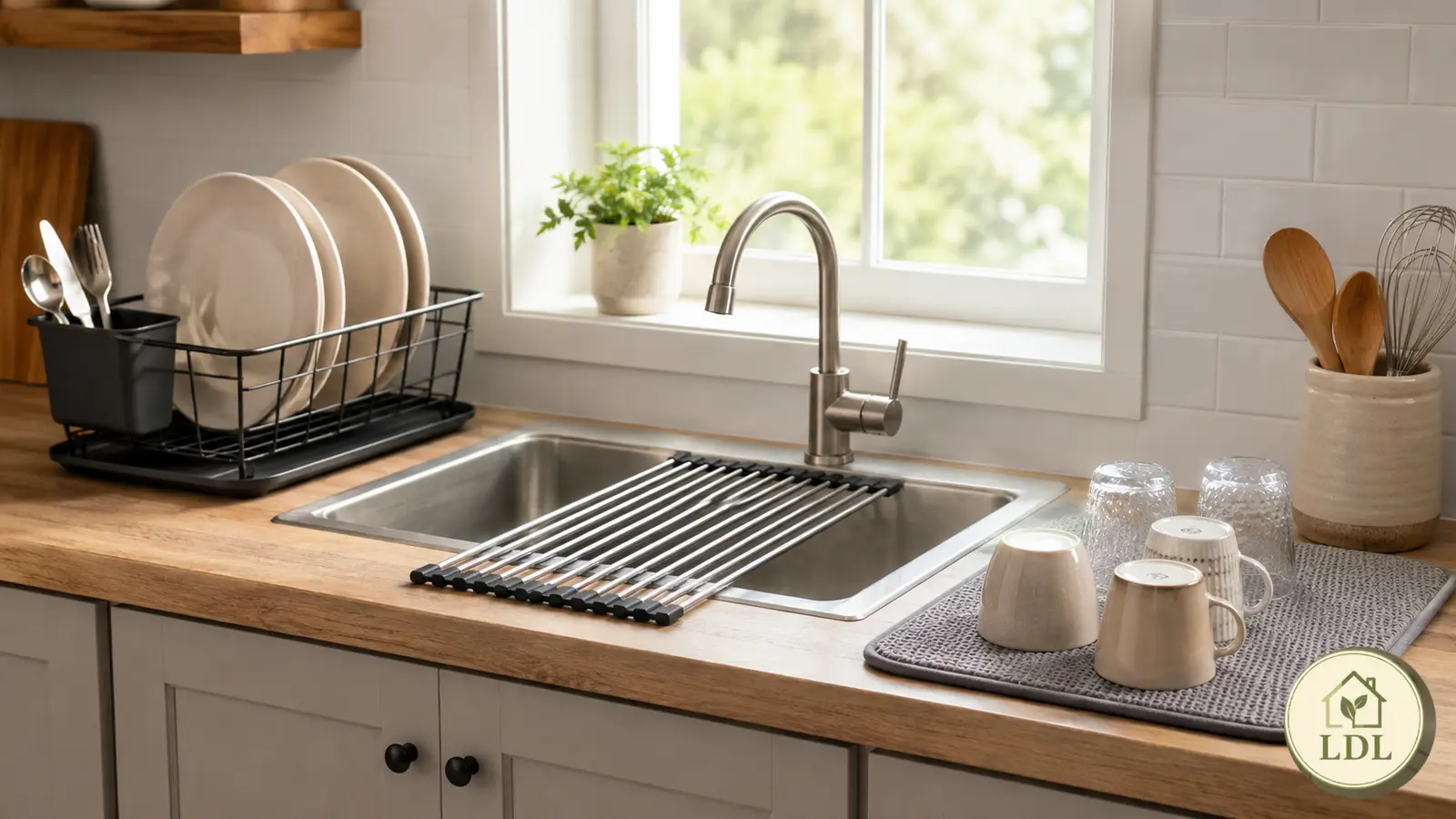
There is a familiar end-of-dinner moment in a small kitchen: the food is put away, the sink is finally emptying, and somehow cleanup still does not feel finished. Wet plates are leaning against bowls. A towel has taken over the prep counter. The dish rack is exactly where you need to make breakfast in the morning. You washed the dishes, but the kitchen still feels occupied by them.
That is why “Which drying setup is best?” is not really one question. You may be trying to protect counter space, dry a larger family load, keep glassware from sliding around, or make the whole setup disappear once the dishes are done. A rigid rack, an over-sink roll-up rack and a drying mat solve those problems differently.
The short version: choose by the problem you keep having
Choose a roll-up rack if your biggest problem is losing the counter.
It spans a compatible sink while in use and rolls into a much smaller shape afterward. The tradeoff is that part of your sink is occupied while dishes are drying.
Choose a compact countertop rack if you want dishes held upright and organized.
You give up a fixed patch of counter, but plates, bowls, glasses and cutlery have structure instead of spreading across a towel or mat.
Choose a drying mat if you want the simplest thing to put away.
It is flexible, washable and easy to fold, but it does not create plate slots or vertical organization. During use, it still occupies the counter area you spread it across.
Choose a full-size rack when capacity matters more than preserving counter.
If you regularly wash a whole meal's dishes, a larger rack may reduce the juggling even though it is the least space-saving option in this comparison.
First, separate “space while drying” from “space after drying”
This is the part that is easy to miss when you shop by product photos. A drying mat can fold into a drawer after use, but an 18 × 24-inch mat still covers a large rectangle of counter while the dishes are wet. A compact rack may have a smaller footprint while it is sitting out, but it usually stays visible between loads unless you have somewhere convenient to store it.
A roll-up rack changes the equation because it uses the sink opening instead of the counter. That can be a real relief when one clear cutting-board-sized patch is the difference between “I can cook here” and “I have to move everything first.” But if you have one sink basin and need it constantly, covering part of the sink may simply move the inconvenience from the counter to the sink.
At a glance
How the three formats use space
Compact countertop rackUses a fixed counter footprint while drying; gives dishes vertical structure and defined slots.
Roll-up over-sink rackUses the sink opening rather than the counter; rolls up after use, but needs stable support on both sides of a compatible sink.
Drying matUses flat counter area while drying; folds or stores easily afterward, but does not hold plates upright by itself.
Option 1: a compact countertop rack for a predictable everyday load
If you are tired of plates sliding into bowls and spoons disappearing under wet cups, a rack earns its counter space by creating order. The structure matters when you want to wash a normal load, leave it alone and come back to dishes that have stayed separated rather than spread across the counter.
In this comparison, the Kitsure Compact Countertop Dish Drying Rack is the smaller rigid-rack example. The selected listing is roughly 12 inches deep × 15.5 inches wide × 5 inches high, and the seller states space for about 10 plates plus bowls and glasses. It also has a drainboard and detachable cutlery holder.
That footprint is not tiny, but it is contained. If your current habit is spreading wet dishes across a tea towel that slowly grows to fill the whole counter, a compact rack can actually make the drying zone feel smaller because it uses height and structure.
Think twice if: your hand-washed load routinely includes several pots and pans, or the 12 × 15.5-inch footprint would occupy the only usable prep space beside your sink. Also check the direction of drainage before assuming the rack will work with your counter layout.
Read our guide to the Kitsure compact rack →
Option 2: a roll-up rack when the counter itself is the problem
For a very small kitchen, this is the option that can create the biggest visual change. Instead of asking, “Where can I fit another thing beside the sink?” you use the sink as the drying zone for a while and reclaim the counter for chopping, packing lunches or simply having one clear surface.
The Surpahs Roll-Up Dish Drying Rack is 20.5 × 13.1 inches in the selected size and is listed for sink openings up to 19.5 inches. The silicone-covered rack is designed to span a compatible sink and then roll up for storage.
This is the strongest choice here if your definition of “saving counter space” means not placing the drying setup on the counter at all. But the sink measurement is not optional. The rack needs secure support on both sides, and unusual sink shapes or narrow ledges can make a theoretically space-saving product unusable.
There is another tradeoff people do not always think about until dinner cleanup: dishes sitting over the sink can limit how freely you use that sink. If you have a double basin, that may barely matter. With one small basin, it may matter a lot.
Think twice if: you need the full sink while dishes dry, your sink opening is wider than the supported span, or you routinely need a higher-capacity drying station.
Read our guide to the Surpahs roll-up rack →
Option 3: a drying mat when flexibility matters more than structure
A mat is the least complicated option. There is nothing to assemble, nothing to fit around a drainboard and no rack permanently announcing itself beside the sink. You spread it out when you need it, wash or dry it according to its care instructions, and fold it away when the counter needs to become a counter again.
The S&T INC. XL Microfiber Dish Drying Mat we documented measures 18 × 24 inches. The listing describes absorbent microfiber, a reversible design and machine-washable care. It can also sit beneath a rack when you need a drip-catching layer.
The important catch is right there in the dimensions: 18 × 24 inches is a broad surface. A mat is extremely easy to store after the dishes are dry, but while it is doing its job it may cover more counter than a compact rack. Because it is flat, dishes also spread outward rather than being held upright in slots.
For a household that hand-washes a few cups, a lunch container and a pan at different times of day, that flexibility can feel easier than maintaining a permanent rack. For a family washing a large dinner load at once, the lack of structure may become the frustration you were trying to solve.
Think twice if: you want plates held vertically, want water directed back into the sink, or tend to leave a damp mat bunched up where it cannot dry thoroughly.
Read our guide to the S&T drying mat →
What if you wash a lot of dishes at once?
Sometimes the urge to “save counter space” is really frustration with a rack that is too small. If every dinner ends with bowls stacked on top of cups because the drying setup cannot handle your normal load, going smaller can create more mess, not less.
The KitchenAid Large Capacity Full-Size Dish Rack is the opposite end of the spectrum. The selected full-size version is approximately 14.96 inches deep × 20 inches wide × 7 inches high, and the seller lists a 25-pound maximum capacity. It has an angled drainboard and removable flatware caddy.
It is not the answer if your main goal is reclaiming a tiny countertop. But if your actual pain is wet dishes overflowing a smaller setup every night, one larger defined drying station may feel calmer than dishes scattered across a rack, a towel and the sink edge.
Think twice if: you cannot comfortably give up about 20 inches of counter width beside the sink. In that case, capacity is solving the wrong problem.
Which one is easiest to put away?
The drying mat is the simplest to fold and store. The roll-up rack is also designed specifically to collapse into a smaller footprint. A rigid countertop rack is the least convenient to put away because its shape stays its shape.
But “can be stored” and “will be stored” are different things. If your only cabinet is already full, a rigid rack will probably live on the counter. If rolling and unrolling an over-sink rack every day annoys you, it may also start living out. Choose the routine you can picture yourself repeating on an ordinary Wednesday, not the one that sounds neat in theory.
Which one is better for a rental or temporary kitchen?
All three formats avoid permanent cabinet installation, but the roll-up rack and drying mat are particularly easy to move with you because they do not depend on a fixed counter drainage setup. The roll-up rack does, however, depend on sink dimensions, so a move can change whether it fits.
If you rent and expect to move, measure before buying and keep the choice simple. A product that works only with one very specific sink can be excellent today and useless in the next kitchen.
Which one is easiest to keep visually calm?
If visual clutter bothers you, the answer depends on when you notice it. A mat and roll-up rack can disappear after use. A compact rack creates a tidier, more contained drying station while it is in use. Those are different kinds of calm.
Think about the moment that bothers you most. Is it seeing the rack sitting there empty all day? Or is it seeing wet dishes spread across the counter after every meal? Your answer points toward the format that will feel lighter in your kitchen.
So, which saves the most counter space?
If your sink is compatible, the roll-up rack is the clear winner for preserving counter space while dishes dry because the drying surface sits over the sink instead of on the counter.
If your priority is having nothing bulky left out afterward, the drying mat is the easiest to fold away—but remember that it can occupy a large flat area while it is in use.
If your priority is keeping a normal daily load upright and contained, a compact rack is the better compromise. It gives up some counter space in exchange for structure.
And if you wash a large load every night, a full-size rack may be the more honest choice. Saving six inches of counter is not much of a victory if half the dishes end up somewhere else.
Decision shortcut
Match the setup to your kitchen, not the label
Small counter + compatible sink: start with a roll-up rack.
Small everyday dish load + want structure: start with a compact countertop rack.
Occasional/light drying + want easy storage: start with a drying mat.
Large family load + enough counter: accept the footprint and consider a larger rack.
If you are still unsure, do the footprint test before spending anything. Space problems are much easier to judge in your own kitchen than in a product photo.
FAQ
Common questions about dish-drying setups
Does a roll-up rack really save more counter space?
It can, because it spans a compatible sink instead of sitting on the counter. The tradeoff is reduced sink access while it is in use, and it only works when the sink opening and supporting ledges fit the rack dimensions.
Is a drying mat better than a dish rack for a small kitchen?
It is easier to fold away, but it is not automatically smaller while in use. The XL mat included in this guide measures 18 × 24 inches, whereas the compact rack example is roughly 12 × 15.5 inches. The mat trades structure for flexibility.
What should I measure before buying a roll-up drying rack?
Measure the clear sink opening and make sure there is a stable ledge on both sides to support the rack. For the selected Surpahs 20.5 × 13.1-inch version, the listing states that it fits sink openings up to 19.5 inches.
What is better if I wash pots and pans by hand?
A higher-capacity rigid rack or a flexible mat may suit cookware better than a very small plate-focused setup, depending on the load. The full-size KitchenAid rack is designed for mixed dishes and some cookware, while the mat gives you a broad flat surface without slots.
Can I use a drying mat under a dish rack?
Yes. The S&T listing specifically describes using the mat beneath a dish rack to catch drips, so the two formats do not have to be mutually exclusive.
Your turn
What limits your dish-drying setup most?
Tell us whether counter space, sink fit, dish volume or daily storage is making the choice difficult.
Comments are reviewed before anything is published. Your response will not appear publicly automatically.
Continue
Keep making the kitchen easier to live with
A note on this guide: Lighter Day Living has not personally tested the products discussed in this comparison. Product dimensions, materials, capacities and care/installation details referenced here come from Amazon listing information reviewed for this guide on August 10, 2026. The comparison is based on those documented characteristics and ordinary space/use considerations; we do not claim laboratory or hands-on performance testing. Product links in this article open Lighter Day Living product guides rather than Amazon directly. Each guide contains clearly labeled Amazon affiliate links. Verify the current retailer listing and measure your own counter or sink before purchasing.