
Decision guide
Magnetic vs Tiered vs Revolving Spice Racks: Which Is Best?
If finding cumin means moving six jars, checking the second shelf, and discovering a duplicate you forgot you owned, the problem is not that you need a prettier spice collection. You need the jars you actually use to stop hiding from you.
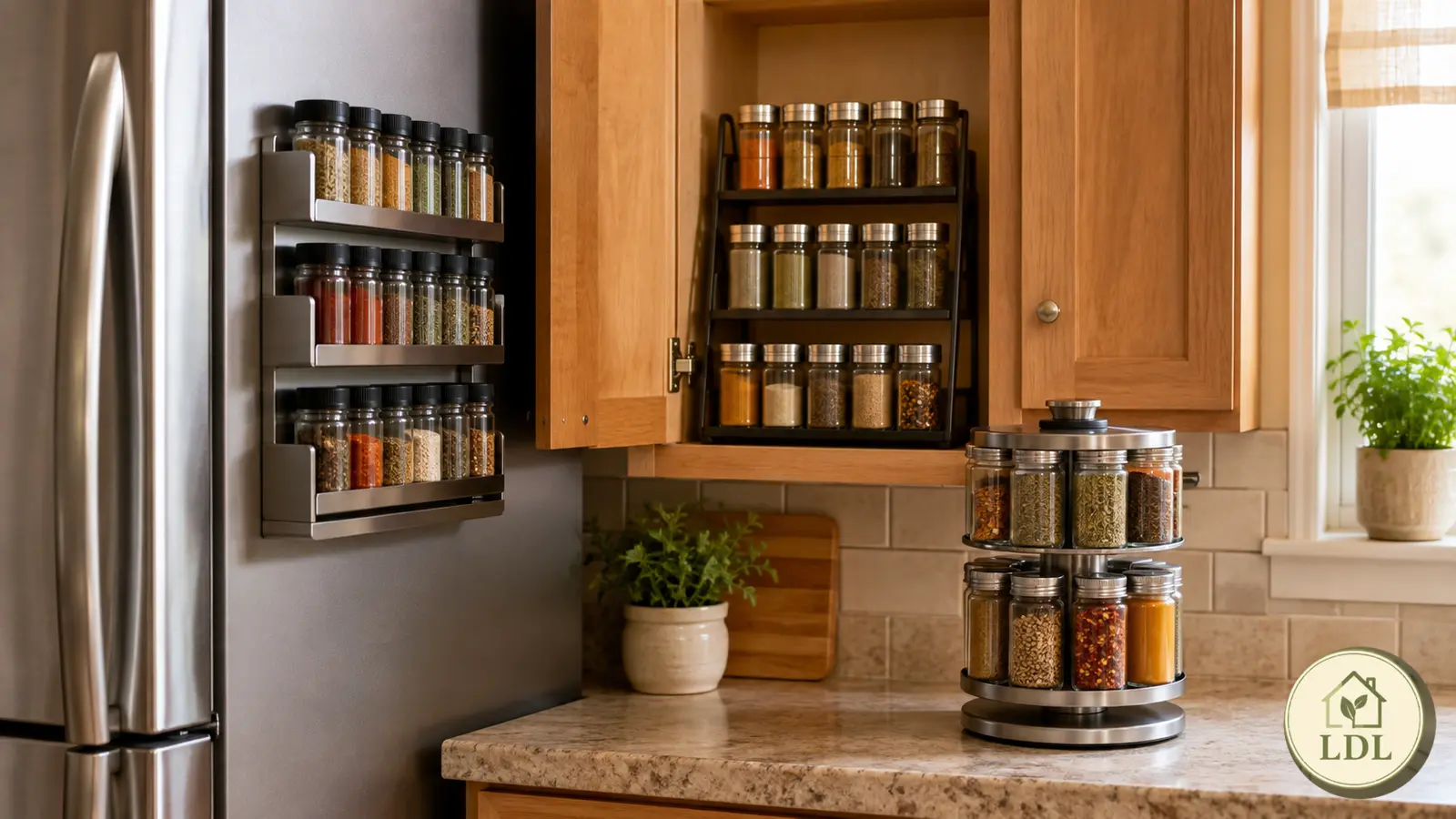
Spices are tiny, which somehow makes the frustration more annoying. You know the paprika is in the kitchen. You probably bought it recently. But all the jars are the same height, the front row blocks the back, and the one you need is behind something you have not touched in six months. Then one day you clean the cabinet and find three bottles of garlic powder.
A spice rack can fix that—but only if you choose the format for the problem you actually have. Magnetic shelves create storage where there was none. Tiered shelves improve visibility inside existing cabinet space. Revolving racks compress a larger collection into a smaller footprint and bring jars around to you.
The short version: match the rack to the frustration
Choose magnetic shelves if your cabinets are full but you have unused magnetic appliance space.
They move spices out of a crowded cabinet without drilling. The tradeoff is that the jars stay visible and the surface must actually be magnetic.
Choose a tiered rack if the real problem is that the back row disappears.
It raises jars in steps so labels are easier to see while keeping the collection inside a cabinet or on a shelf.
Choose a revolving rack if you want many spices together in one compact station.
Rotation makes a dense collection easier to scan, but a prefilled set can duplicate spices you already own and needs enough vertical clearance.
First, do not organize spices you do not actually use
Before comparing racks, pull the spices into one place and make three small groups:
- use all the time;
- use occasionally;
- forgot I had this.
If six seasonings appear in most of your meals, those six deserve the easiest access. A beautiful organizer that gives equal priority to forty jars can still make everyday cooking slower than a simple shelf with your most-used seasonings at the front.
Also check for duplicates before you buy storage. Sometimes the cabinet feels too small because the same spice exists in two or three half-used bottles. Consolidating what is appropriate and removing expired or unwanted items may solve more than another rack.
At a glance
What each format actually changes
Magnetic shelvesCreate new storage on a compatible magnetic surface; best when cabinet space itself is scarce.
Tiered shelfUses existing cabinet/counter space but raises back rows so labels are easier to see.
Revolving rackStores jars around a rotating vertical station; best when you want a concentrated spice collection in one accessible spot.
Option 1: magnetic spice racks when you need storage more than another shelf
If every cabinet shelf already has a job, the side of a refrigerator can feel like wasted real estate. Magnetic spice storage changes the location rather than trying to squeeze one more organizer into the same crowded cabinet.
The HuggieGems Magnetic Spice Rack Organizer comes as four magnetic metal shelves in the selected pack. The captured listing shows approximately 11.8 × 4.33 × 4.33 inches for the displayed dimensions and describes no-drill magnetic attachment to compatible metal surfaces.
The practical advantage is access. Your frequently used spices can stay at eye or hand level instead of behind pantry food, mugs or cooking oils. It can also be useful for renters because there is no permanent mounting involved.
But magnetic storage has a very clear failure point: your intended surface has to be magnetic. Some appliance panels that look metallic are not strongly magnetic. Test the exact area with a household magnet before ordering.
Also look at the space around the appliance. A shelf projecting from the side of a refrigerator may be perfectly convenient in an open kitchen and irritating in a narrow passage where someone brushes past it all day.
Think twice if: you want the spices visually hidden, your appliance side is not magnetic, or you do not have enough clearance around the shelf location.
Read our guide to the HuggieGems magnetic spice racks →
Option 2: a tiered spice rack when the jars fit—but you cannot see them
This is the classic cabinet problem: technically, every spice fits. Practically, the front row makes the back row invisible.
A tiered shelf does not create new cabinet volume. It uses height to make the existing volume easier to scan. That distinction matters. If the cabinet is already packed so tightly that jars are wedged side by side with no room to reach the back, tiers may improve labels without fixing access.
The Zri Bamboo 3-Tier Expandable Spice Rack adjusts from about 12.7 to 22.2 inches long, is approximately 7.7 inches deep and about 4.3 inches high. The seller lists tier depths around 2.28–2.56 inches.
That expandable width is useful because cabinet sizes vary. You can keep it narrower in a compact cabinet or spread it across a wider shelf. The stepped design also lets you keep your existing jars rather than buying a matching jar system simply for appearance.
The limitation is bottle size. Large seasoning containers, grinders or unusually wide jars may not sit comfortably on the listed tier depth. Measure the widest jars you actually use—not the smallest ones that would make the organizer look good in a product photo.
Think twice if: your cabinet is shallower than the roughly 7.7-inch footprint, you mainly own large spice bottles, or your real issue is lack of shelf space rather than hidden labels.
Read our guide to the Zri expandable tiered spice rack →
Option 3: a revolving spice rack when you want one concentrated spice station
A revolving rack solves a different kind of irritation: instead of several spice rows stretching across a cabinet, the collection wraps around a central tower. You rotate the rack until the jar you need comes forward.
The Kamenstein 20-Jar Revolving Countertop Spice Rack is approximately 8.5 inches wide and deep and 13.5 inches high. The selected set includes 20 prefilled glass spice jars with labeled caps and removable sifter inserts.
If you are starting a spice collection from scratch, that can be appealing: the rack and jars arrive as one coordinated system. If you already own twenty spices you like, the exact same feature can become the drawback. You may end up with duplicate seasonings, extra packaging and a second set of jars to manage.
The height also matters more than the base. An 8.5-inch footprint can look compact on a counter, but a 13.5-inch tower needs enough clearance under upper cabinets—and enough room above it to remove jars comfortably.
The captured listing also advertises a five-year spice-refill program. We treat that as a seller/manufacturer offer, not a guaranteed benefit; current registration, eligibility, shipping and fulfillment terms should be checked before treating it as part of the value.
Think twice if: you already own most of the included spices, dislike keeping appliances/organizers on the counter, or do not have enough vertical clearance.
Read our guide to the Kamenstein 20-jar revolving rack →
Which one saves the most cabinet space?
Magnetic shelves win if the goal is to move spices out of the cabinet entirely. They create a new storage location on a compatible appliance surface.
A revolving rack can also free cabinet space if you are comfortable keeping the spice station on the counter. The tiered rack does not remove spices from the cabinet; it makes the cabinet you already have easier to read.
So “space-saving” needs a location attached to it. Saving cabinet space by using the counter is not a win if the counter is already your biggest problem.
Which one makes spices easiest to find?
For a modest collection inside a cabinet, a tiered shelf is probably the simplest visibility fix because the labels rise above each other. For a larger coordinated collection, rotation can make scanning easier because you bring the jars around instead of reaching behind them.
Magnetic racks are especially good for frequency-based access: put the seasonings you use constantly on the magnetic shelves and leave occasional baking spices or specialty blends elsewhere. You do not have to move your entire spice collection just because you move the six jars that cause the most daily searching.
Which one is better for a tiny kitchen?
There is no automatic winner because “tiny kitchen” can mean three different shortages.
- Tiny cabinets but an exposed magnetic refrigerator side: magnetic storage can be extremely efficient.
- Enough cabinet width but poor visibility: tiered storage uses the space you already have without adding something to the counter.
- Enough counter depth but narrow cabinet shelves: a revolving tower can consolidate the collection outside the cabinet.
If both the cabinet and counter are cramped, do not buy a rack until you reduce the number of spices competing for prime space. The least-used jars can live higher, deeper or in a secondary pantry area.
Which one looks the least cluttered?
If visual calm matters to you, a tiered rack inside a cabinet keeps the whole collection behind a door. A magnetic rack makes the jars more visible by design. A revolving rack becomes part of the countertop.
That is not merely aesthetic. If seeing items reminds you to use them, visible storage can be helpful. If seeing twenty jars makes the kitchen feel busier even when they are perfectly organized, hidden cabinet storage may feel better.
Which one works best if your jars are all different sizes?
Magnetic shelves are the most forgiving of mixed jar shapes as long as the jars physically fit the shelf. A tiered rack can work well with mixed brands too, but large containers may exceed the tier depth and block labels behind them.
A prefilled revolving set gives you the most uniform-looking collection because the jars are supplied together. But uniformity only helps if the included spices match what you actually cook with. Matching jars are not useful if the seasonings you reach for every day are still sitting somewhere else.
Do you need to decant spices into matching jars?
No. If your current jars close properly, fit the storage method and are easy to identify, decanting is optional.
Matching jars can make labels and dimensions consistent, but they also create work: transferring spices, labeling them, keeping track of refill dates and storing any excess that does not fit. Do it because it solves a real problem for you—not because every spice cabinet online seems to have identical bottles.
Try this 10-minute spice test before buying anything
You can usually identify the right format without buying first.
- Put every spice you use weekly on the counter. This is your priority group.
- Count how many jars are duplicates or nearly empty. Consolidate only where appropriate.
- Look at the intended storage location. Is the problem no space, hidden labels or too many scattered jars?
- Test the refrigerator side with a magnet if magnetic storage is an option.
- Measure cabinet width, depth and bottle diameter if you are considering tiers.
- Mark an 8.5 × 8.5-inch square on the counter and check 13.5 inches of height if a revolving rack appeals to you.
Then leave the measurements in place through one ordinary cooking session. If the proposed rack blocks a cabinet door, consumes your chopping space or sits exactly where someone always puts the coffee maker, you have learned something before spending money.
So, magnetic, tiered or revolving—which is best?
Magnetic is best when you need to create storage outside an already crowded cabinet.
Tiered is best when your spices fit in the cabinet but the back row keeps disappearing.
Revolving is best when you want many spices together in one compact station and you have the counter/cabinet height for it.
If you are still undecided, do not start with the rack. Start with the sentence: “I am tired of ______ every time I cook.” If the blank is “having nowhere to put the jars,” think magnetic. If it is “not seeing what I own,” think tiered. If it is “having spices scattered everywhere,” think revolving.
Decision shortcut
Choose by the problem, not the prettiest setup
“My spice cabinet is completely full.” Test magnetic storage on an unused compatible appliance side.
“I keep buying duplicates because I cannot see the back.” Try a tiered rack.
“I want my whole collection together and easy to scan.” A revolving rack may fit better.
“My counter is already crowded.” Do not solve cabinet clutter by automatically moving twenty jars onto the counter.
“I only use six spices most weeks.” Give those six better access before reorganizing everything else.
FAQ
Common questions about magnetic, tiered and revolving spice racks
Are magnetic spice racks good for small kitchens?
They can be particularly useful when cabinet and counter space are tight but you have an unused compatible magnetic appliance side. Test the exact surface first because not every metal-looking refrigerator panel is strongly magnetic.
Do tiered spice racks actually make the back row easier to see?
That is their main advantage. The stepped levels raise the second and third rows so labels are less likely to sit directly behind the front row. They do not create more cabinet volume, so very crowded shelves may still need decluttering.
Is a revolving spice rack better than a tiered rack?
Not universally. Revolving racks are useful when you want a concentrated collection you can rotate toward you. Tiered racks are better when you want to keep your existing jars inside a cabinet and simply improve visibility.
What should I measure before buying a tiered spice rack?
Measure the cabinet width and depth and the diameter of your widest jars. The Zri example expands from about 12.7 to 22.2 inches long, is about 7.7 inches deep, and lists tier depths around 2.28–2.56 inches.
How much counter space does a revolving spice rack use?
The Kamenstein example discussed here has an approximately 8.5 × 8.5-inch base and is about 13.5 inches high. Check both the footprint and the vertical clearance before choosing a countertop or under-cabinet location.
Your turn
Where do your spices become difficult to find or reach?
Tell us about your cabinet, counter or refrigerator space and the jars you use most often.
Comments are reviewed before anything is published. Your response will not appear publicly automatically.
Continue
Make the kitchen easier to use, not just nicer to look at
A note on this guide: Lighter Day Living has not personally tested the products discussed in this comparison. Product dimensions, materials, pack sizes, included jars and installation/care details come from Amazon listing information reviewed for this guide on August 10, 2026. The Kamenstein refill program is a seller/manufacturer offer whose current eligibility and fulfillment terms should be verified on the retailer listing or packaging. Product links in this article open Lighter Day Living product guides rather than Amazon directly. Each guide contains clearly labeled Amazon affiliate links. Measure your cabinet, counter and intended appliance surface before purchasing.