Entryway & Closet Organization
Messy Entryway? Create a Drop Zone for Shoes, Bags & Keys
You do not need a mudroom or a wall of matching baskets. You need a few obvious homes for the things that keep landing by the door—and a system simple enough to survive an ordinary rushed day.
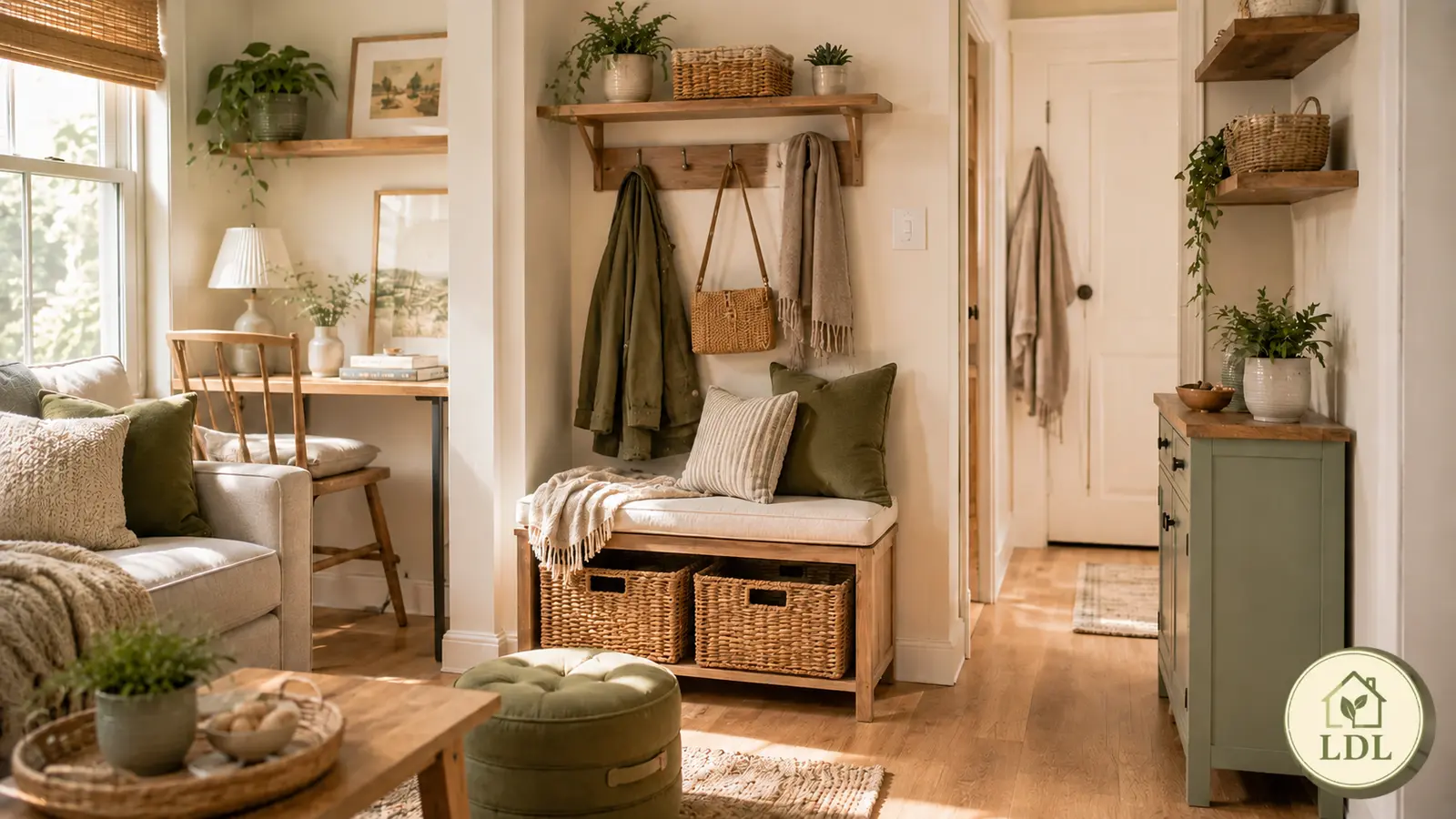
The front door can collect an impressive amount of chaos in a very small space. Shoes get kicked off wherever there is room. A bag lands on a chair. Keys make it to the kitchen counter. A jacket gets draped over the nearest surface. Then the next morning, the same things have to be found again while somebody is already asking where their shoes are.
That is what makes entryway clutter so frustrating: you are not just looking at mess. You are looking at tomorrow's search problem. Every item left without a clear home becomes another decision when everyone is trying to leave.
A useful drop zone is simply the place where everyday leaving-and-returning items stop. It can be one narrow wall, a small corner, the inside of a closet door, a shelf beside the entrance or even a basket under a console table. The size matters less than whether the system answers one question quickly: where does this go when we walk in?
1. Start with the traffic—not the furniture
It is easy to look at an empty wall and think, “I need an entryway bench.” But the better first question is: what keeps crossing this doorway?
For many households, the repeat traffic is surprisingly small:
- the shoes worn most days;
- one everyday bag per person;
- keys, wallet or access card;
- coats or outer layers currently in season;
- one child-related item such as a school bag, stroller accessory or outing bag;
- anything that must leave again tomorrow.
Those items deserve the easiest positions. Everything else should either move deeper into the home or into longer-term closet storage.
If twelve pairs of shoes are sitting at the door but only four are worn this week, the first organization tool is not a bigger shoe rack. It is moving the other eight pairs somewhere else.
2. Give every high-frequency item a one-motion home
A system is much easier to maintain when putting something away takes roughly one motion.
Think about the difference between:
- dropping keys into a small tray versus opening a drawer, moving something and placing them inside;
- hanging a daily bag on one accessible hook versus carrying it to another room;
- sliding shoes into one open spot versus lifting a lid and rearranging a packed bin.
The more tired, rushed or distracted your household is at the moment of arrival, the simpler the return action needs to be. A beautiful system that requires five steps will usually lose to the floor.
That does not mean everything must be visible. It means the items used every day should have the lowest-friction storage.
3. Separate “today's shoes” from shoe storage
Shoes can take over an entryway faster than almost anything else because each person may have several pairs in rotation. If every pair lives by the door, even a large shoe organizer can look full immediately.
Try a simple limit: keep only the shoes currently used most often in the drop zone. Seasonal, occasional and backup pairs go in the closet, bedroom or another storage area.
For a family, that might mean one or two pairs per person near the entrance. The exact number does not matter. What matters is that the door area does not become the permanent home for the entire shoe collection.
If shoes repeatedly spread across the walking path, mark a clear boundary with what you already have—a tray, low shelf, mat or defined section of floor. Sometimes the visual boundary is enough to stop the category from expanding.
4. Put bags where they are easiest to grab again
A bag that is used every day should not have to disappear into deep storage each evening. But it also should not migrate from chair to sofa to kitchen table depending on who came through the door last.
Choose one place based on the bag's weight and the user's height:
- a sturdy wall or freestanding hook for a frequently used bag;
- a low hook or cubby for a child's school bag;
- a shelf or basket for smaller purses and reusable shopping bags;
- a dedicated spot for the family outing bag so it can be refilled rather than rebuilt.
If you install wall-mounted hooks, use hardware appropriate for the wall and the expected load. A hook is only convenient if the installation is suitable for what you regularly hang on it.
Related: Family Outing Bag Checklist: Stop Forgetting What You Need →
5. Make keys and pocket items boringly predictable
Keys do not need an elaborate storage system. They need one place that never changes.
A small bowl, tray, hook or existing drawer near the entrance can work. Add only the things that truly need to travel with you—perhaps keys, access card, wallet or sunglasses. If the tray becomes a home for receipts, coins, batteries, random screws and three months of paper, the important items disappear again.
Think of this as a departure tray, not a miscellaneous tray.
If one essential cannot live there—for example, a phone that charges in another room—keep the system realistic. Put everything else together and use one visible reminder for the exception rather than redesigning your whole home around it.
6. Give children a place they can actually reach
A family drop zone becomes much more useful when children can participate without needing an adult to complete every step.
If it is appropriate for your child's age, keep their everyday items low and obvious: a hook they can reach, a shoe area they can recognize, or a small basket for hats and simple outdoor accessories.
The goal is not perfect independence. It is to make “put your bag here” easier to follow than “take your bag somewhere in the house and put it away properly.”
Simple visual categories can help too. You may not need labels at all if each child has one clear hook and one shoe spot. If you do label, use words or simple pictures that make sense to the people actually using the space.
7. Keep tomorrow's exceptions visible
The everyday system handles repeat items. The things that derail mornings are often the exceptions: library books that must go back, a signed form, swimming clothes, a package to return, a reusable bag needed for shopping.
Create one temporary “leaving tomorrow” spot. It can be a basket, a tote, one section of a shelf or even a clearly designated place beside the door.
This is not permanent storage. It is a short-term holding area for items that need to cross the door soon.
Without that distinction, temporary items become permanent entryway clutter. With it, you can see why something is sitting there.
Related: Rushed Mornings? 7 Things to Prep the Night Before →
8. Do not let seasonal gear live at the door all year
Entryways often feel too small because four seasons are trying to occupy the same square meter.
If the weather is hot, winter gloves and heavy scarves probably do not need premium door space. In cold weather, summer hats and beach items can move elsewhere. Rotate the category rather than trying to fit everything at once.
A nearby closet shelf can hold out-of-season accessories in a simple bin. Clear storage can help when you want to see what is inside without opening several containers. The SKTEET Set of 8 Clear Plastic Storage Bins, for example, includes four large and four small open bins with built-in handles and is presented for multi-room household storage.
Think twice before buying a set like this: the bins have no lids, the supplied listing information does not clearly assign the published dimensions to each individual bin size, and eight bins may be far more than you need for one closet. A single basket you already own may solve the seasonal-accessory problem perfectly well.
Read our guide to the SKTEET clear storage-bin set →
9. Decide whether your entryway needs seating—or simply less stuff
A bench can be useful if people genuinely sit to put on shoes, if you need concealed storage or if one piece can replace several smaller storage items. But a bench is still furniture. In a narrow entrance, it can solve one problem and create another by taking up precious walking space.
Before buying one, tape out the footprint on the floor and live with that boundary for a day or two. Can the door open fully? Can people pass without turning sideways? Can a stroller, shopping bag or child move through comfortably?
The SONGMICS MAZIE 43-Inch Folding Storage Ottoman Bench is one option that the listing positions for entryway seating and concealed storage. The selected version is about 43 inches wide, 15 inches deep and 15 inches high.
That can make sense if you have a clear 43-inch stretch and want one object to provide both a seat and hidden storage. It makes much less sense if your entrance is already tight or if open hooks and a small shoe boundary would solve the actual problem with no new furniture.
Think twice if: fabric upholstery will be difficult to maintain in a wet or muddy entryway, you need rigid permanent furniture, or the 43-inch width would narrow the traffic path. The seller lists a high maximum load figure, but Lighter Day Living has not independently load-tested the bench.
Read our guide to the SONGMICS storage bench →
10. Create a return-home reset that takes less than two minutes
The entryway will get messy again. That is not a sign that the system failed. The real test is whether it can recover quickly.
A simple return-home sequence might be:
- shoes into the shoe boundary;
- bag onto its hook or shelf;
- keys into the departure tray;
- coat onto its hook or hanger;
- anything that belongs elsewhere leaves the entryway with you.
If this takes ten minutes, there are probably too many categories at the door. If you have to open several containers or move other people's things first, simplify the storage.
A drop zone should make the correct action easier, not ask everyone to become unusually organized every evening.
11. What if you have no real entryway?
Many apartments and small homes open directly into a living room, kitchen or hallway. You can still create a drop zone without pretending you have a mudroom.
Use the smallest useful footprint:
- one wall: hooks plus a narrow shoe boundary;
- one side of a closet: everyday bags and current-season outerwear;
- one shelf: keys, wallet and tomorrow items;
- one basket: reusable bags or seasonal accessories;
- one corner: a compact seat only if you genuinely need seating.
The drop zone does not need to look like a separate room. It needs to function like a transition point.
Related: Small-Space Storage →
A 15-minute entryway drop-zone reset
If the door area is bothering you right now, do not wait for a full organizing day. Set a 15-minute timer.
- Minutes 0–3: remove anything that does not need to live near the door.
- Minutes 3–6: choose the everyday shoe limit and move the extras.
- Minutes 6–9: assign one place for keys and one place for everyday bags.
- Minutes 9–12: create a temporary “leaving tomorrow” spot.
- Minutes 12–15: stand at the door and test the flow—walk in, put everything away, then pretend you are leaving again.
At the end, write down the one physical problem that remains. Maybe you truly need a stronger hook, a shoe shelf, one shallow basket or seating. That is the moment to shop—after the system has told you what is missing.
Keep it simple
A good entryway drop zone makes tomorrow easier, not just tonight tidier
Keep only high-frequency items near the door.
Give shoes, bags and keys one-motion homes.
Separate permanent everyday storage from temporary “leaving tomorrow” items.
Rotate seasonal gear instead of storing every season at the entrance.
Buy furniture or organizers only after you know which repeated problem remains.
The goal is not an empty entryway. It is a doorway that stops stealing time from you twice—once when you come home and again when you are trying to leave.
FAQ
Common questions about creating an entryway drop zone
What should be in an entryway drop zone?
Keep the items that repeatedly enter and leave the home: everyday shoes, frequently used bags, keys, current-season outerwear and a small place for temporary items that need to leave soon. Avoid turning the drop zone into general household storage.
How do I organize an entryway without a mudroom?
Use one small boundary instead of trying to create a separate room. A wall with hooks, one closet section, a narrow shoe area and a small key tray can function as a drop zone even when the front door opens directly into another room.
How many pairs of shoes should stay by the door?
There is no universal number. Keep the pairs your household is actively wearing and move occasional or out-of-season shoes elsewhere. The useful limit is the number that fits without spreading into the walking path.
Should I buy an entryway bench?
Only if seating or concealed storage solves a real problem and the footprint does not obstruct the doorway. Tape out the dimensions first. In a narrow entrance, hooks and a smaller shoe boundary may work better than adding furniture.
How do I stop the entryway from becoming messy again?
Make the return actions very easy and reduce the number of things allowed to live there. A system that takes less than two minutes to reset is more likely to recover after a busy day than one that requires sorting several containers.
Your turn
What keeps landing in the wrong place near your door?
Tell us which shoes, bags, keys or leaving-home essentials make the entryway difficult to maintain.
Comments are reviewed before anything is published. Your response will not appear publicly automatically.
Continue
Make leaving home easier from both sides of the door
A note on this guide: Lighter Day Living has not personally tested the products mentioned in this guide. Product dimensions, materials and listing claims referenced here come from Amazon listing information reviewed for this guide on August 10, 2026. The organization advice is general and should be adapted to your own doorway dimensions, wall type and household routine. Product links in this article open Lighter Day Living product guides rather than Amazon directly. Each guide contains clearly labeled Amazon affiliate links. Verify current retailer and installation details before purchasing.