
Cleaning & Home Reset
A 10-Minute Home Reset for Days When Everything Feels Messy
When every room seems to be asking for something at once, the goal is not to clean the whole house. It is to make the next hour feel easier to live in.
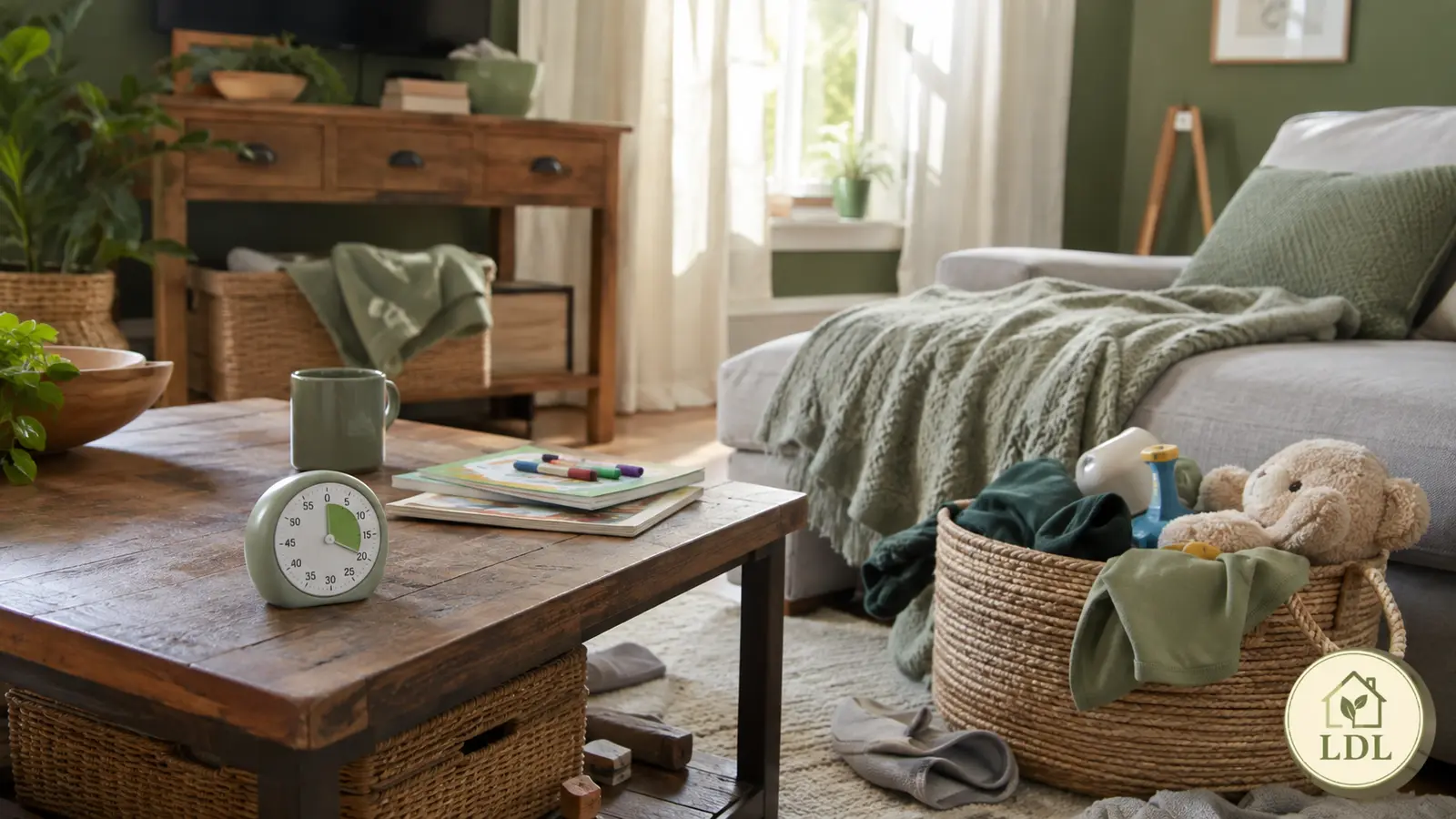
Some days, the mess is not one dramatic disaster. It is a cup on the coffee table, shoes by the door, clean laundry waiting on a chair, toys under your feet, breakfast dishes still near the sink and three things on the bathroom counter that somehow make the whole room feel untidy.
You walk into one room to put something away, notice something else, carry that into another room, remember the dishwasher, see the floor, think about the laundry—and suddenly the house feels like one enormous unfinished task.
That is usually the moment when advice like “just clean as you go” is least useful. You are not looking for a perfect cleaning system. You are looking for enough visible relief that your brain can stop keeping a running list of everything that is out of place.
Why a messy house can feel bigger than the actual mess
Visible clutter competes for attention. So do unfinished tasks. When several small jobs are spread across several rooms, they can feel like much more work than the same number of things contained in one place.
That is why the best ten-minute reset does not begin with “What needs cleaning?” It begins with:
What is making the house hardest to use right now?
If the kitchen counter is covered, you may not have anywhere to make dinner. If the entryway is blocked, leaving tomorrow morning will already feel harder. If toys cover the floor, walking through the room is irritating. If the bathroom counter is full, even brushing your teeth can feel like working around clutter.
The reset should target those points of friction first.
Before the timer starts: choose only three zones
This is the part that keeps a 10-minute reset from quietly becoming a 45-minute cleaning session.
Look around and choose the three places whose improvement would give you the most immediate relief. For example:
- kitchen counter + sink;
- living-room floor + coffee table;
- entryway;
- bathroom counter;
- dining table;
- the path between the rooms you use most.
You are deliberately ignoring the rest for ten minutes. That is not failure. It is prioritization.
If the laundry room is messy but you are not using it tonight, it may not deserve one of your three zones. If a bedroom drawer is disorganized but the kitchen is preventing you from cooking, the drawer can wait.
Minute 0–2: collect the obvious things that do not belong
Do not organize yet. Do not open drawers. Do not start deciding where every random object should permanently live.
Pick up the obvious out-of-place items from your three zones. Use your arms, a laundry basket, a tote or any container you already own as a temporary collection basket.
Examples:
- cups and plates that belong in the kitchen;
- toys that belong in a child's room or toy zone;
- clothes that belong in a hamper or bedroom;
- mail or papers that belong in one paper spot;
- shoes that belong by the door;
- products that wandered out of the bathroom.
The rule is simple: collect first, distribute second. Walking each object to its final home one at a time burns your ten minutes in travel.
If you discover that the same tiny categories constantly have nowhere obvious to go—hair accessories, chargers, small toys, packets, cleaning cloths—that is an organization problem to solve later. A visible open bin can help some categories, but do not pause the reset to redesign the storage system.
Minute 2–4: restore one useful surface
Choose the surface that would make the biggest practical difference if it were usable again.
That might be:
- one section of the kitchen counter;
- the dining table;
- the bathroom vanity;
- the coffee table;
- the bench or shelf by the door.
Do not aim for “styled.” Aim for available.
A clear 60-centimeter patch of counter where you can make dinner is more useful tonight than perfectly arranging every cupboard. An empty dining-table corner where the family can sit is more valuable than sorting a drawer nobody will open until the weekend.
Related: How to Organize a Small Kitchen When You're Out of Space →
Minute 4–6: deal with the mess that spreads
Some messes stay where they are. Others keep multiplying.
A full sink creates nowhere to put the next dish. A pile of shoes invites more shoes. An overflowing trash bin attracts things around it. A bathroom counter with no open space makes every new item land on top of another item.
Use these two minutes on one “spreading” problem:
- load or stack the dishes so the sink edge becomes usable;
- take out a full trash bag;
- put shoes into one row or basket;
- move dirty clothes into the hamper;
- return daily bathroom products to their one daily-use zone.
If the kitchen sink repeatedly feels messy because the sponge, brush and soap have no defined place, fix that recurring problem separately rather than buying something in the middle of a reset. A compact sink caddy such as the simplehuman stainless-steel sink caddy can help when the problem is specifically loose sink tools—but it will not solve a sink full of dishes or too many cleaning products.
Read our guide to the simplehuman sink caddy →
Think twice before buying: if your sponge and brush already have a workable home, another counter/sink organizer simply becomes one more thing to clean around.
Minute 6–8: make the floor and pathways easier to move through
You do not need to vacuum the whole house. You are looking for the few things that make the room feel physically difficult.
Pick up what is underfoot. Push chairs back where they belong. Move the bag sitting in the walkway. Return the shoes that migrated into the middle of the room. Put large toys against the wall or into their main storage zone.
This part matters because a room can still look imperfect and immediately feel better once you can walk through it without stepping around things.
If toys are the category that makes the floor unusable every single day, that is not a cue to keep doing longer resets. It is a cue to simplify the toy-storage system. The dedicated guide on organizing kids' toys without a complicated system explains how to make everyday cleanup easier to repeat.
Read: How to Organize Kids' Toys Without Fighting the Clutter →
Minute 8–10: set up the next part of the day
The last two minutes should not be spent polishing something nobody cares about. Use them to make the next transition easier.
Ask: what happens next?
If dinner is next, clear the prep surface and put away the unrelated things. If bedtime is next, move the pajamas or bedtime items where they are needed. If you are resetting at night, put tomorrow's bags and keys near the door. If you are about to sit down, clear the place where you want to sit.
This is what makes the reset feel useful instead of decorative. You are not cleaning for an imaginary visitor. You are helping the people who actually live there move into the next part of the day with less friction.
Related: Rushed Mornings? 7 Things to Prep the Night Before →
What if ten minutes barely makes a difference?
Sometimes it will not. If the house has been accumulating unfinished tasks for several days, ten minutes may only expose the amount of work underneath.
That does not make the reset useless. It tells you something.
Look at what consumed the time:
- You spent the whole reset relocating objects. Too many things may not have easy homes.
- You could not clear a surface because there was nowhere else for the items to go. That room may have a storage/access problem.
- You kept stopping to make decisions. You may need simpler categories or one temporary “decide later” tray.
- One category dominated everything. That category needs its own system rather than repeated whole-house cleaning.
- The reset became cleaning. You may need to separate “restore function” from “scrub, wash, dust and vacuum.”
This is where a reset becomes diagnostic. The recurring mess shows you where the home is asking too much from your routine.
If the same room keeps exploding, fix the return path
A basket can hold clutter. A good system makes it easy to put something away at the moment you are finished with it.
If bathroom products repeatedly return to the counter, the daily-use storage may be too full or too inconvenient. If shoes never make it to the closet, the shoe home may be too far from where they come off. If kitchen tools live in three drawers, the tool you use every night may simply be stored in the wrong place.
Related: Small Bathroom Storage Ideas for Counters That Never Stay Clear →
Related: Messy Entryway? Create a Drop Zone for Shoes, Bags & Keys →
If visibility is the repeated issue—for example, small supplies disappear into deep opaque baskets—an open clear bin can make sense. The SKTEET set of clear storage bins includes large and small handled bins, but a full set is unnecessary if you only have one problem category.
Read our guide to the SKTEET clear storage-bin set →
Try this first: use any open basket, box or tray you already own for one week. If the category becomes easier to return and easier to find, then you know the storage format works before spending money on a matching set.
Do not use the reset to hide everything
There is a tempting version of a quick reset where every loose item gets swept into a drawer, basket or spare room because the visible room looks better instantly.
That can be useful once in a genuine rush, but if it becomes the routine, tomorrow's problem is simply hidden.
A “decide later” basket is fine if it has a limit and a regular time to empty it. A basket that permanently stores unidentified household objects is not a reset system. It is delayed decision-making.
The same applies to laundry. Moving clean clothes from the sofa to a bedroom chair may make the living room look better, but it has not completed the task. Sometimes that is still the right choice for tonight—just call it what it is so the unfinished task does not disappear from your mental map.
You do not need to reset every room every night
A home is not a showroom that closes at 8 p.m. People live in it. Children play. Food gets prepared. Clothes get changed. The bathroom gets used again tomorrow.
If you try to return every room to perfect condition every night, the reset can become another obligation hanging over the end of the day.
Instead, pick the rooms that make tomorrow easier:
- the kitchen if breakfast/dinner prep depends on it;
- the entryway if mornings are rushed;
- the living area if clutter is making it hard to relax;
- the bathroom if the counter is blocking the routine;
- the dining table if it needs to function again in the morning.
Some nights your ten minutes will be the kitchen. Some nights it will be toys and the entryway. The routine should follow the friction, not a rigid checklist.
A simple 10-minute reset checklist
- Choose three zones. Ignore the rest temporarily.
- 0–2 minutes: collect obvious out-of-place items.
- 2–4 minutes: restore one useful surface.
- 4–6 minutes: stop one mess that keeps spreading.
- 6–8 minutes: clear the main floor/pathway.
- 8–10 minutes: prepare the space for what happens next.
The point of the reset
Make the house easier to live in—not perfect to look at
Choose the spaces causing the most friction.
Restore function before deep cleaning.
Collect first so you do not waste time walking room to room.
Use recurring clutter as information about systems that are not working.
Stop when the timer ends. Ten minutes is useful partly because it has a boundary.
A good reset should leave you with less visual noise and fewer obstacles between you and whatever the family needs to do next.
FAQ
Common questions about a 10-minute home reset
What is a home reset?
A home reset is a short routine that restores basic function after everyday clutter accumulates. It is different from deep cleaning because the priority is usable surfaces, clear pathways, dishes/trash and returning obvious items—not completing every cleaning task.
Can ten minutes really make a messy house feel better?
It can make the highest-friction areas noticeably easier to use, but it will not clean an entire messy house. The key is choosing two or three zones rather than spreading the ten minutes across every room.
What should I clean first when the whole house feels overwhelming?
Start with whatever is interfering with the next part of your day: a blocked kitchen counter, dishes in the sink, clutter underfoot, a crowded entryway or a surface you need to use. Function is a more useful first priority than choosing the room that looks worst.
Should I use a basket during a quick reset?
A temporary collection basket can save time because you can gather misplaced items before distributing them. Avoid turning it into permanent mystery storage; empty it after the reset or at a defined later time.
How often should I do a home reset?
As often as it genuinely reduces friction. Some households find a short evening reset useful; others only need one on particularly busy days. The routine should not become another rigid standard you feel you have failed when you skip it.
Your turn
What makes a 10-minute home reset difficult in your home?
Tell us where the reset usually slows down, expands into a bigger job or gets abandoned.
Comments are reviewed before anything is published. Your response will not appear publicly automatically.
Continue
Fix the places where the same mess keeps returning
A note on this guide: The reset routine in this article is general household organization advice and should be adapted to your home, family and available time. Lighter Day Living has not personally tested the products mentioned here. Product details referenced in our linked product guides come from Amazon listing information reviewed for this guide. Product links in this article open Lighter Day Living product guides rather than Amazon directly. Each guide contains clearly labeled Amazon affiliate links. You do not need to buy an organizer to use this routine; existing baskets, boxes and storage should be tried first when they can solve the same problem.