
Bathroom & Vanity Organization
Small Bathroom Storage Ideas for Counters That Never Stay Clear
If you clear the vanity at night and somehow wake up to toothbrushes, skincare, hair tools and half-used bottles everywhere again, the problem may not be that you need more storage. Your everyday things may simply be living in places that are too hard to use.
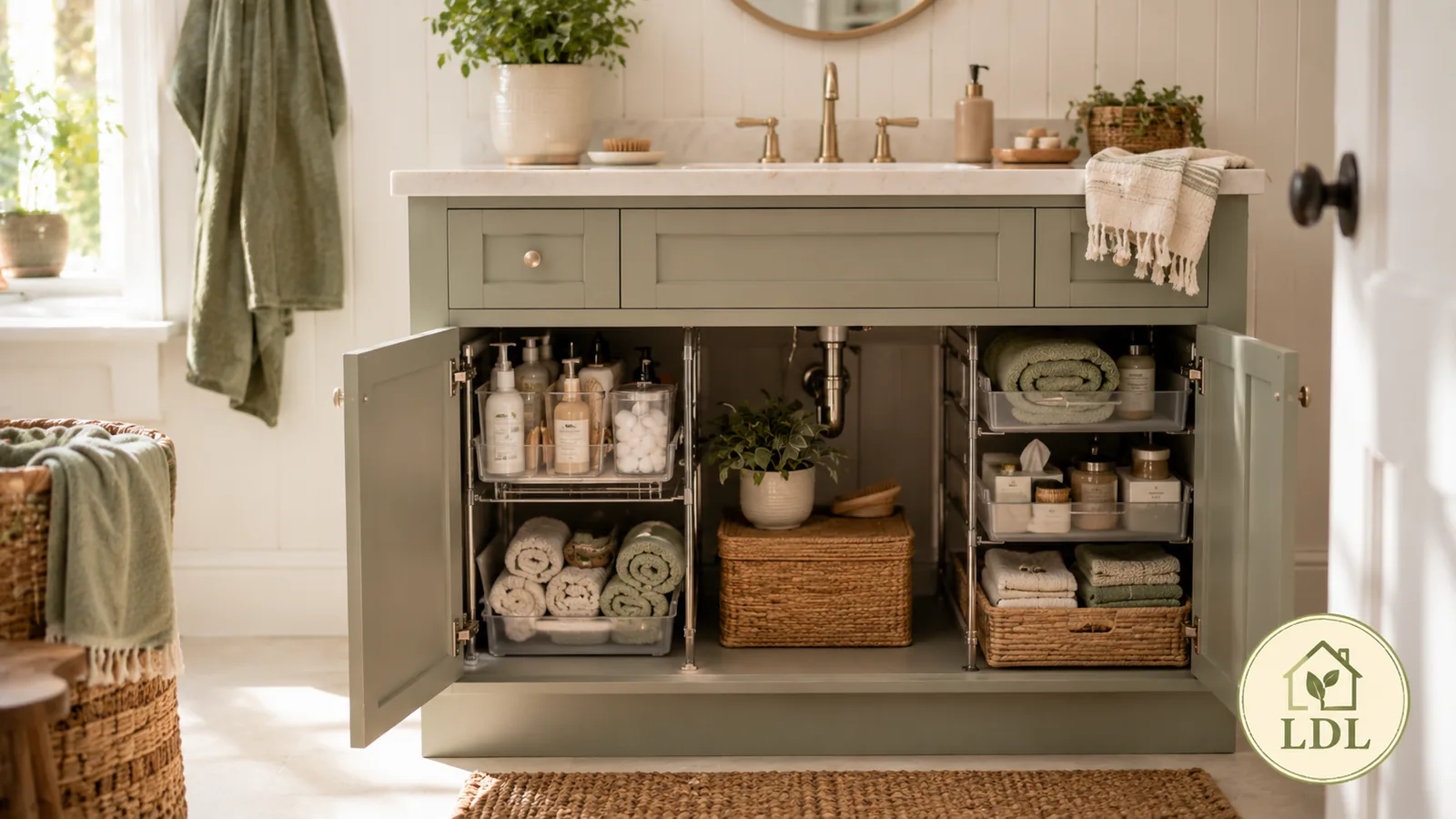
A small bathroom can look messy before the day has properly started. You put everything away, wipe the counter and feel relieved for about five minutes. Then someone brushes their teeth. Skincare comes out. A hair dryer lands beside the sink. A fresh toilet-paper roll has nowhere obvious to go. By the time everyone is ready, the counter looks exactly the way it did before you cleaned it.
That cycle is exhausting because it makes you feel as if you are constantly tidying the same room. But often the real problem is not that people are careless. It is that the things used every single day do not have homes that are easy enough to return them to.
In a small bathroom, every inch has to do more work—but that does not mean filling every inch with organizers. The goal is to decide what deserves quick access, what can move into vertical or hidden storage, and what should leave the bathroom altogether.
1. Stop asking the counter to store the whole bathroom
The bathroom counter feels convenient, so everything slowly earns a place there: toothbrushes, cleanser, moisturizer, makeup, hair products, medicines, spare toiletries, cotton swabs, perfume, clips, razors and whatever someone was too rushed to put away.
The trouble is that a small counter can only support a few active categories before it becomes difficult to wipe, easy to knock things over and visually noisy.
Start by separating bathroom items into three groups:
- Daily: things used almost every morning or evening.
- Weekly/occasional: masks, extra styling products, specialty tools, backup razors and similar items.
- Backups: unopened toothpaste, soap, toilet paper, duplicate skincare and refill products.
Only the daily group should compete for the easiest space. Once backups and occasional items move elsewhere, the counter often needs much less “organizing” than you expected.
2. Create one small daily-use zone instead of several little piles
If five products genuinely need to stay visible, trying to hide all five can make the routine harder. But letting them spread across the whole vanity makes cleaning frustrating.
Give daily items one defined boundary: a tray you already own, one open section of an organizer, a shallow basket or a small corner of the counter. The boundary matters because it tells the category where to stop.
For example, your everyday zone might hold only:
- toothbrush/toothpaste;
- daily cleanser and moisturizer;
- one deodorant;
- one frequently used hair or grooming item.
Everything else earns a different home.
When the daily zone starts overflowing, do not immediately buy a bigger organizer. First ask whether every item in it is still genuinely daily.
3. Treat under-sink space like a map, not an empty rectangle
Under-sink cabinets are frustrating because the outside looks spacious while the inside is broken up by pipes, valves, hinges and awkward corners. Pushing one large bin into the cabinet can leave a lot of unusable space behind it.
Instead, measure the usable rectangles beside the plumbing. One side may support a narrow pull-out organizer while the other side is better for taller bottles or a cleaning caddy.
The Vtopmart 4-Pack Pull-Out Bathroom Under-Sink Organizers are one example of this narrow-lane approach. The selected S-Standard units are listed at about 11.8 inches deep × 7.5 inches wide × 10 inches high, with two pull-out levels.
That narrow width can be useful beside plumbing because items at the back slide forward instead of disappearing behind the front row.
Think twice before buying them: a rectangular organizer cannot use space occupied by pipes or hinges, and bottles wider than the 7.5-inch footprint may not fit well. Measure the actual clear area inside the cabinet and make sure each drawer can pull forward before ordering.
Read our guide to the Vtopmart under-sink organizers →
4. Use the space above the toilet only if it solves a real storage problem
The wall above the toilet is often one of the largest unused vertical areas in a small bathroom. That can make over-toilet storage genuinely useful for extra toilet paper, folded towels, backup toiletries or baskets of less-frequently used items.
But vertical storage is not automatically good storage. A tall rack that crowds the toilet, blocks access to the shutoff valve or feels unstable creates a new problem.
The Kalrin 4-Tier Over-the-Toilet Storage Rack is a freestanding option included in this guide. The listing shows a height of about 68.11 inches and roughly 24 inches of width, with adjustable shelves, a lower basket and stabilizing hardware.
Before considering a rack like this: measure toilet-tank height, overall width, baseboards, wall fixtures and valve access—not only the empty floor area. Because it is tall and freestanding, use the supplied stabilization/wall-fixing hardware where appropriate rather than assuming the feet alone are enough.
Read our guide to the Kalrin over-toilet rack →
5. Move shower bottles off the tub edge and floor
Shampoo bottles lined along the tub edge seem harmless until you have to move six of them to clean, knock one over with your elbow or discover that smaller items are always hiding behind the bigger bottles.
If your shower has no useful built-in shelf, vertical corner storage can concentrate those bottles into one zone without taking over the floor.
The SEIRIONE 4-Shelf Shower Corner Caddy Tension Pole uses four adjustable baskets on a tension pole rather than drilled wall mounting. The seller lists a broad 34–116 inch height range.
That makes it worth considering when you have a suitable flat ceiling and want several shower-storage levels without drilling tile.
Think twice if: your ceiling is sloped, either contact surface is unstable, or you expect to load the caddy near its maximum. The listing itself contains two different load figures (22 lb and 24 lb), so we would treat the lower 22-lb figure as the conservative ceiling and follow the current installation instructions.
Read our guide to the SEIRIONE shower caddy →
6. Give hair tools a home that is not “beside the sink”
Hair dryers, straighteners and curling tools are especially good at making a small counter feel unusable. They are long, corded, awkward to stack and often left out because putting them away feels inconvenient.
If styling tools repeatedly land on the vanity, consider storing them vertically on a suitable cabinet door or wall instead of asking a drawer to hold them horizontally.
The YIGI 3-in-1 Adjustable Hair Dryer & Hair Tool Holder is a stainless-steel organizer with three tool zones and adjustable hanging height. The selected holder body is listed at about 10.62 inches wide × 4.33 inches deep × 7 inches high.
It can make sense when you have an appropriate cabinet door and want the dryer, straightener/curling iron and brushes stored together instead of spread across the counter.
Think twice if: cabinet hinges or interior shelves leave very little clearance, your tools are unusually large, or you plan to hang it on a room door—the seller specifically says that use is not recommended. Even though the listing discusses hot-tool storage, verify the current heat-use instructions for your specific appliances before placing very hot tools into any organizer.
Read our guide to the YIGI hair-tool holder →
7. Decide whether makeup should live on the counter at all
Makeup organizers can be helpful, but they can also become a more attractive version of the same clutter if every product you own is packed onto the vanity.
Before buying one, separate your makeup into:
- products used most days;
- products used occasionally;
- duplicates, expired items or things you no longer reach for.
If the daily collection is small, one existing cup for brushes plus a drawer may be enough. If you actually use a larger mix of bottles, palettes, brushes and small cosmetics every day, a divided organizer can reduce the “everything in one pile” problem.
The HBlife Large Makeup Organizer with Brush Holder combines two drawers with open top compartments and brush slots. It is a substantial countertop organizer: Amazon Product Information lists roughly 14.3 × 7.6 × 10.2 inches, while seller copy shows a slightly smaller set of dimensions.
Think twice if your counter is already tiny. An organizer cannot create surface area; it still needs a footprint of roughly 14 × 8 inches. Because the listing provides two different dimension sets, use the larger measurements as the safer planning estimate and recheck the current listing before purchase.
Read our guide to the HBlife makeup organizer →
8. Put backups farther away than the products you are actively using
A small bathroom often feels “full” because active products and unopened backups are sharing the same premium space.
You probably do not need three extra tubes of toothpaste within arm's reach of the sink. Backups can live on an upper shelf, over the toilet, in a linen closet or in one labeled bin elsewhere in the home.
This creates a simple rule:
- Daily product: easiest access.
- Open but occasional product: drawer/cabinet access.
- Unopened backup: secondary storage.
When the active item runs out, bring one replacement forward. That is easier to maintain than storing the entire household inventory beside the sink.
9. Give every category a limit, not just a container
A bin labeled “hair products” can still overflow. A shelf labeled “skincare” can still become impossible to use. Containers help most when the category has a boundary.
Try simple capacity rules:
- one daily skincare tray;
- one drawer for occasional cosmetics;
- one shelf for backup toiletries;
- one shower zone per person or product type;
- one defined area for toilet-paper backstock.
If the category no longer fits, review the category before expanding the storage. Sometimes you really do need more capacity. Other times you are storing six versions of the same thing because the container made room for them.
10. Leave some empty counter on purpose
In a small bathroom, empty space is functional. You need somewhere to place a toothbrush while brushing, set down a contact-lens case, rest a grooming tool briefly, wipe around the sink or help a child wash their hands without knocking over five bottles.
If every inch of the vanity is permanently occupied, daily tasks have nowhere to happen.
So do not judge the success of your organization by how much you managed to store on the counter. Judge it by how quickly the counter can recover after the morning rush.
A good small-bathroom setup often looks almost too simple: one daily zone, some open working space and the rest stored vertically or behind doors.
Related: Small-Space Storage →
11. Make the reset shorter than the routine that creates the mess
The bathroom will not stay untouched. That is not the goal. Toothpaste will come out. Towels will be used. Hair tools will leave their holders. Someone will put a bottle in the wrong place.
The useful question is: can the room return to normal in two or three minutes?
A quick evening reset might be:
- return daily products to the daily zone;
- move hair tools back to their storage spot;
- put shower products back in their basket/caddy;
- move anything that belongs in another room out of the bathroom;
- wipe the now-clear part of the counter.
If this repeatedly takes ten or fifteen minutes, the bathroom probably contains too many categories or the storage is too difficult to use.
Related: A 10-Minute Home Reset for Days When Everything Feels Messy →
A 20-minute small-bathroom reset you can do today
If the bathroom is bothering you right now, you do not need to redesign it. Set a 20-minute timer and work only on the repeated friction.
- Minutes 0–4: remove obvious trash, empty packaging and anything that belongs in another room.
- Minutes 4–8: separate daily products from occasional products and unopened backups.
- Minutes 8–12: clear one usable section of the counter and create one daily-use boundary.
- Minutes 12–16: map the under-sink cabinet and move backups away from premium access space.
- Minutes 16–20: identify the one storage problem that still remains—shower bottles, hair tools, under-sink access, toilet-paper backstock or makeup.
Only after that final step should you decide whether an organizer would actually solve something.
Keep it workable
A small bathroom does not need to hold everything equally close
Keep daily essentials easiest to reach.
Move backups and occasional products out of premium space.
Measure around plumbing before buying under-sink storage.
Use vertical space only where it does not compromise access or stability.
Leave some counter empty so the bathroom still has room to function.
The goal is not a bathroom that never gets messy. It is a bathroom that stops asking you to reorganize the same mess every day.
FAQ
Common questions about small bathroom storage
How do I get more storage in a small bathroom without remodeling?
Start by separating daily items from backups, then use existing cabinets more deliberately. If storage is still genuinely missing, look at narrow under-sink lanes, suitable vertical space above the toilet, shower corners, cabinet-door storage and other areas that do not consume additional walking space.
What should stay on a bathroom counter?
Usually only the small group of products you use almost every day. Keep them in one defined zone so the rest of the surface remains usable and easy to wipe. Occasional products and backups generally do not need permanent counter space.
How do I organize under the bathroom sink around pipes?
Measure the usable rectangles on each side of the plumbing, including pipe, hinge and valve clearance. Narrow pull-out organizers may work in one lane while taller bottles fit in another. Do not choose storage based only on the cabinet's outside dimensions.
Is over-the-toilet storage good for a small bathroom?
It can be useful when the toilet zone has adequate width, height and access around the tank and valves. Tall freestanding storage should also be stabilized according to the manufacturer's instructions. If the room is already visually crowded, a simpler shelf or existing closet may be better.
How do I keep a small bathroom counter clear every day?
Make putting daily items away easier than leaving them out. Use one obvious daily-use zone, keep backups elsewhere, give hair tools and shower products separate homes, and aim for a two- or three-minute evening reset rather than expecting the bathroom to stay untouched.
Your turn
Which part of your small bathroom is hardest to keep clear?
Tell us where toiletries, towels or daily tools keep competing for limited space.
Comments are reviewed before anything is published. Your response will not appear publicly automatically.
Continue
Keep solving the spaces that refill themselves
A note on this guide: Lighter Day Living has not personally tested the products mentioned in this guide. Product dimensions, materials, installation details and listing claims referenced here come from Amazon listing information reviewed for this guide on August 10, 2026. The organization advice is general and should be adapted to your own bathroom dimensions, plumbing, wall/ceiling conditions and household routine. Product links in this article open Lighter Day Living product guides rather than Amazon directly. Each guide contains clearly labeled Amazon affiliate links. Verify current retailer, fit and installation details before purchasing.