
Kids' Organization
How to Organize Kids' Toys Without Fighting the Clutter
If you keep putting the toys away and the room looks chaotic again before the day is over, the problem may not be that your family needs to tidy more. The toy system may simply be asking everyone to do too much.
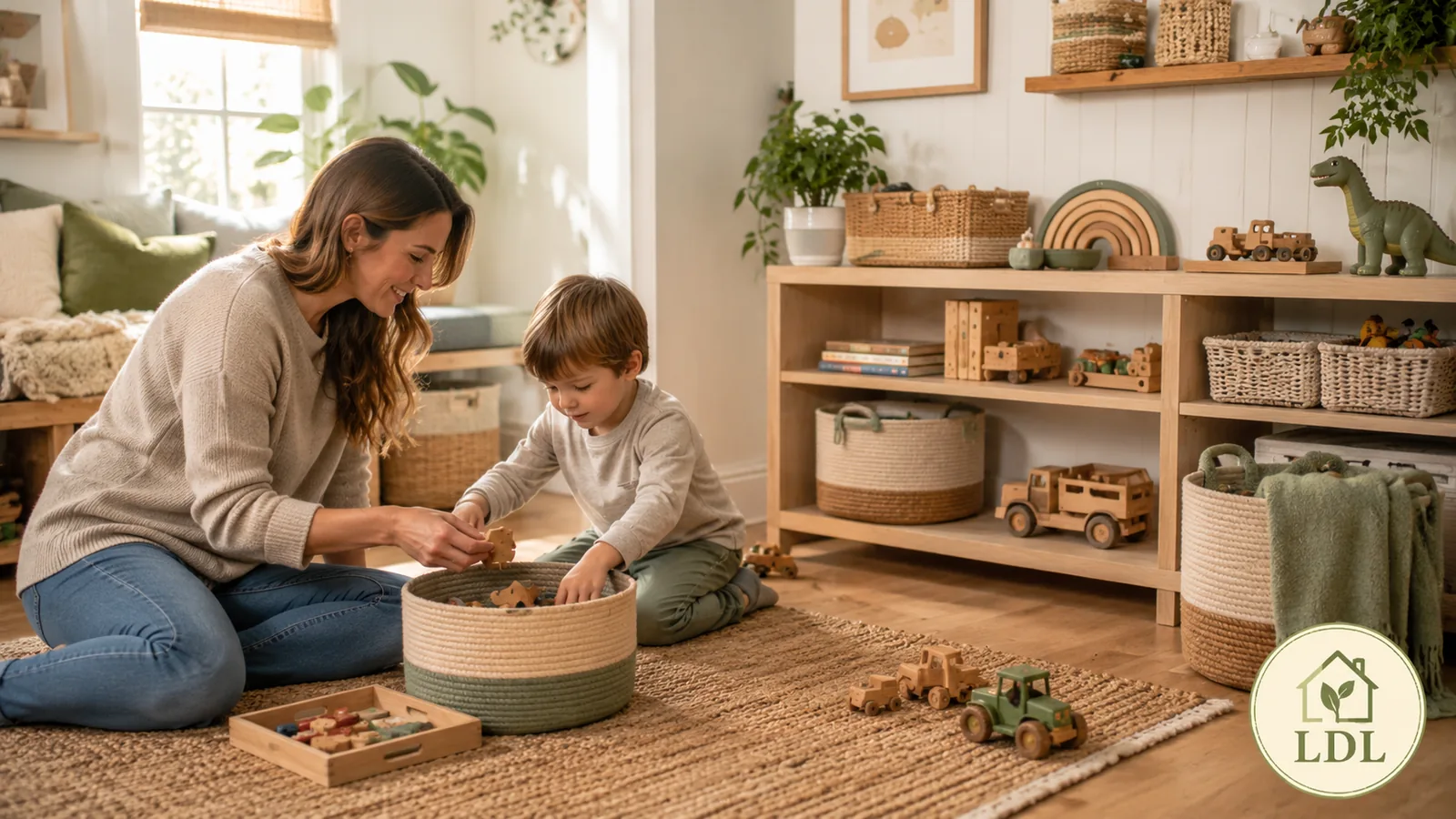
There is a particular kind of frustration that comes from cleaning up toys at night, stepping around the last stray block, finally seeing the floor again—and then watching the same room unravel the next morning. Cars are under the sofa. Puzzle pieces are mixed into a basket of pretend food. Stuffed animals have somehow multiplied across the bed. The art supplies you put away yesterday are back on the table.
After enough rounds of this, it is easy to think the answer is stricter cleanup, more storage or a beautifully labeled toy room.
But many toy systems fail for a simpler reason: they are easier for an adult to design than for a child to use. There are too many categories, the containers are too full, the favorite toys are stored too far away, or cleanup requires several decisions for every object.
The goal is not to keep a home with children looking untouched. It is to make the mess recoverable—so toys can come out, be enjoyed, and return to places that make sense without turning cleanup into an argument every single time.
1. Stop trying to organize every toy at once
When the whole play area feels overwhelming, the natural instinct is to empty everything, sort every piece and create a perfect system in one afternoon.
That can work for a photograph. It often does not survive real family life.
Start with the category creating the most repeated mess. Maybe it is blocks. Maybe it is pretend food. Maybe it is dozens of tiny cars that travel into every room. Maybe it is art supplies that never make it back to the same drawer.
Fix one category first. Give it a clear boundary and watch what happens for a week. If cleanup becomes easier, you have learned something useful about the kind of system your household can maintain.
This also prevents you from buying ten matching bins before knowing whether bins are even the right answer.
2. Reduce the number of decisions required during cleanup
A toy system can look beautifully organized and still be exhausting to maintain.
If every wooden animal has one tiny bin, every type of block has another, every doll accessory has its own compartment, and every vehicle is separated by size, cleanup becomes a sorting exercise.
For many families, broader categories are easier:
- cars and vehicles instead of six vehicle subcategories;
- building toys instead of separating every compatible piece;
- pretend play for food, utensils and small role-play accessories;
- animals and figures together if they are usually played with together;
- art supplies with only the messier or adult-supervised materials separated.
The best category is not the most precise one. It is the one your family can identify quickly enough that putting toys away does not require a conference.
3. Give the most-used toys the easiest homes
Adults sometimes put the favorite toys in the nicest-looking storage. Children need something different: the easiest possible return path.
If a toy comes out every day, its home should be:
- easy to reach;
- easy to open;
- large enough that the toy does not have to be arranged perfectly;
- close to where it is usually played with.
Save high shelves, closed boxes and tucked-away storage for toys that are used less often.
This is the same principle we use throughout Lighter Day Living: frequent-use items deserve premium access. If a child has to ask for help every time a favorite toy needs to be put away, the system is dependent on an adult from the beginning.
4. Make the container big enough for an imperfect cleanup
One reason toys end up beside the bin instead of inside it is surprisingly practical: the container is already packed to the top.
A toy basket should have enough spare room that a child can drop items in without carefully arranging them. If every cleanup requires stacking blocks exactly, folding costumes tightly or pushing a lid down while something catches at the edge, the system has no breathing room.
Try removing roughly one category's worth of toys from an overflowing area before buying a larger container. If the same bin suddenly becomes easy to use, volume—not storage capacity—was the real problem.
You can move the extras into a temporary rotation box, donate what is no longer used, or simply store lower-frequency toys somewhere else.
5. Use open storage for toys that need fast cleanup
Open baskets and bins are not always the prettiest option, but they remove steps. There is no lid to find, latch to open or drawer to pull out while holding an armful of toys.
They work especially well for categories where the exact item does not matter much during cleanup: blocks, stuffed animals, balls, larger cars, dress-up items or pretend-play pieces.
If visibility helps, the SKTEET clear storage-bin set is one example of open transparent storage. The set includes four large and four small handled bins, and the seller lists playroom use among several household applications.
Think twice before buying it: the bins have no lids, the listed dimensions are not clearly assigned to each size in the product information we captured, and eight bins may be more than you need. Try an existing basket or box first. If one open-bin category consistently stays easier to manage, then buying a better-fitting version may make sense.
Read our guide to the SKTEET clear storage-bin set →
6. Use drawers for the things you do not want visually spreading everywhere
Not every toy category works well in an open basket. Small craft supplies, puzzle pieces, cards, tiny figures or mixed activity materials can make an open shelf look chaotic even when technically organized.
That is where drawers can help. The important part is not simply hiding the items—it is making sure each drawer still has a broad, obvious job.
For example:
- one drawer for coloring supplies;
- one for stickers and paper activities;
- one for puzzles or card games;
- one for small figures.
The Vtopmart clear stackable storage drawers are narrow pull-out drawers that can stack vertically while keeping the contents visible.
Think twice if: your toys are bulky, your child cannot comfortably access the drawer location, or you are trying to solve an overflow problem by adding more compartments. The inner drawer width is only about 5.8 inches according to the seller copy we recorded, so these make more sense for genuinely small categories than large toys.
Read our guide to the Vtopmart stackable drawers →
7. Create a toy rotation only if too many choices are part of the problem
Toy rotation is often presented as something every organized family should do. It is not.
If your children happily use the toys they have and cleanup is manageable, there is no need to create another system to maintain.
Rotation can help when:
- the available toy volume overwhelms the storage;
- children regularly dump several containers just to find one item;
- many toys are ignored because everything is visible at once;
- you want to keep some toys but do not need them accessible every day.
Keep it simple. Put one or two lower-frequency categories away, not half the room. You do not need a complicated calendar for bringing them back.
A rotation system should reduce visible volume. If it creates three new labeled boxes, a spreadsheet and another task you have to remember every Friday, it has become heavier than the clutter it was supposed to solve.
Related: Small-Space Storage Ideas When You're Running Out of Room →
8. Keep play zones loose rather than creating a miniature classroom
When different activities constantly collide, a loose play zone can help. This does not mean buying special furniture for every kind of play.
It can be as simple as:
- blocks and vehicles staying near the floor area where they are usually used;
- books staying near the reading spot;
- art materials living close to the table where drawing happens;
- pretend-play toys staying in one part of the room rather than several unrelated baskets.
When the toy home is close to the activity, cleanup becomes physically shorter. That matters more than an elaborate label system.
9. Give “homeless” toys one temporary landing basket
Some toys do not fit neatly anywhere. A party favor appears. A toy from the car comes inside. Three puzzle pieces turn up under the sofa. A random plastic animal somehow belongs to a set you cannot find.
Without a plan, these objects collect on shelves, counters and windowsills.
Use one small temporary basket for the genuinely undecided pieces. The important word is temporary.
Once or twice a week, return those items to their real categories, decide whether they need a new home, or remove the things nobody is actually using.
Do not create several “miscellaneous” bins. One bounded catch-all can absorb exceptions; six of them become a new clutter system.
10. Teach the system by using it together, not by explaining it once
A storage system that seems obvious to an adult may not be obvious to a child. Instead of introducing the whole room at once, practice one category together.
“All the cars go here.”
Then use that same home repeatedly. If the category still creates confusion after several cleanups, simplify it rather than assuming the child simply needs another reminder.
For younger children, pictures or very broad visual categories may make more sense than written labels. For older children, the system can become more specific if they actually want the separation.
The goal is not to prove that the labels are correct. The goal is for the room to be understandable enough that cleanup does not depend on one person knowing the entire system.
11. Do not organize more toys than the space can realistically hold
This is the uncomfortable part, because sometimes the problem is not the organizer.
If every container is full, shelves are doubled up and new toys have nowhere to go, another clever storage product can delay the decision without solving it.
Ask:
- Which toys are actually being used?
- Which are outgrown or no longer interesting?
- Which are duplicates in function?
- Which are worth storing for later rather than keeping in the daily play area?
You do not need to make dramatic decisions in one afternoon. But the available storage needs a limit. Otherwise every new toy automatically turns into a storage problem.
12. Make the floor the first cleanup priority
When the play area is very messy, trying to restore every shelf perfectly can make cleanup feel endless.
Start with the floor.
Collect the largest categories first. Return obvious items. Clear the walking area. Once the floor is usable again, decide whether anything else actually needs attention tonight.
This works especially well on busy days because the goal is visible and finite. You are restoring function, not trying to reset the entire room to showroom condition.
Related: A 10-Minute Home Reset for Days When Everything Feels Messy →
A simple 20-minute toy reset
- Minutes 0–3: remove trash, broken packaging and obvious items that belong in another room.
- Minutes 3–7: gather one high-volume category such as blocks, cars or stuffed animals.
- Minutes 7–11: put the most-used toys into the easiest-to-reach homes.
- Minutes 11–14: pull out toys that are outgrown, ignored or better suited to rotation.
- Minutes 14–17: simplify any category that takes too many decisions to put away.
- Minutes 17–20: clear the floor and stop. Do not reorganize every drawer just because the timer has momentum.
The toy-system rule
Make putting toys away easier than leaving them out
Use broad categories when detailed sorting creates friction.
Give favorite toys the easiest homes and lower-frequency toys the less convenient storage.
Leave room inside containers so cleanup does not require perfect arranging.
Rotate only when visible volume is genuinely part of the problem.
Fix recurring clutter one category at a time.
A toy room does not need to stay tidy all day. It needs to be simple enough that the family can recover it without starting a battle every evening.
FAQ
Common questions about organizing kids' toys
What is the easiest way to organize a lot of kids' toys?
Start by reducing visible volume and using broad categories that are easy to recognize. Put frequently used toys in open or easy-access storage near the play area, then move lower-frequency toys to rotation or less convenient storage.
Are bins or drawers better for toy storage?
Open bins are usually easier for fast cleanup and bulky toy categories. Drawers can work better for small items, craft supplies or categories you want visually contained. The better option depends on what is being stored and who needs to access it.
How many toy categories should I create?
As few as you can while still making the toys easy to find. If cleanup requires too much sorting, combine related categories. You can always separate a category later if it becomes too crowded.
Does toy rotation really help with clutter?
It can help when too many toys are competing for limited play and storage space. It is not necessary if your current toy volume is manageable, and it should stay simple enough that maintaining the rotation does not create extra work.
What should I do with toys that do not belong anywhere?
Use one small temporary catch-all basket, then empty it regularly. Avoid creating multiple miscellaneous containers because they tend to become permanent storage for items nobody knows how to categorize.
Your turn
What makes your children’s toy system hard to maintain?
Tell us which toys, storage choices or cleanup steps keep creating the same mess again.
Comments are reviewed before anything is published. Your response will not appear publicly automatically.
Continue
Make the rest of the space easier to recover too
A note on this guide: This guide offers general household organization ideas, not developmental or behavioral advice. Adapt storage access and toy placement to your children's ages, your home and the specific items being stored. Lighter Day Living has not personally tested the products mentioned here. Product details come from Amazon listing information reviewed for this guide. Product links in this article open Lighter Day Living product guides rather than Amazon directly. Each guide contains clearly labeled Amazon affiliate links. You do not need to buy new storage to use this system; existing baskets, boxes and drawers are the first things to try.