
Pantry & Fridge Organization
How to Organize a Small Pantry When You Can't Find Anything
If dinner starts with moving three things to reach the rice, snacks disappear behind backup groceries, and you keep buying food you already own, the pantry does not need to look prettier first. It needs to become easier to use.
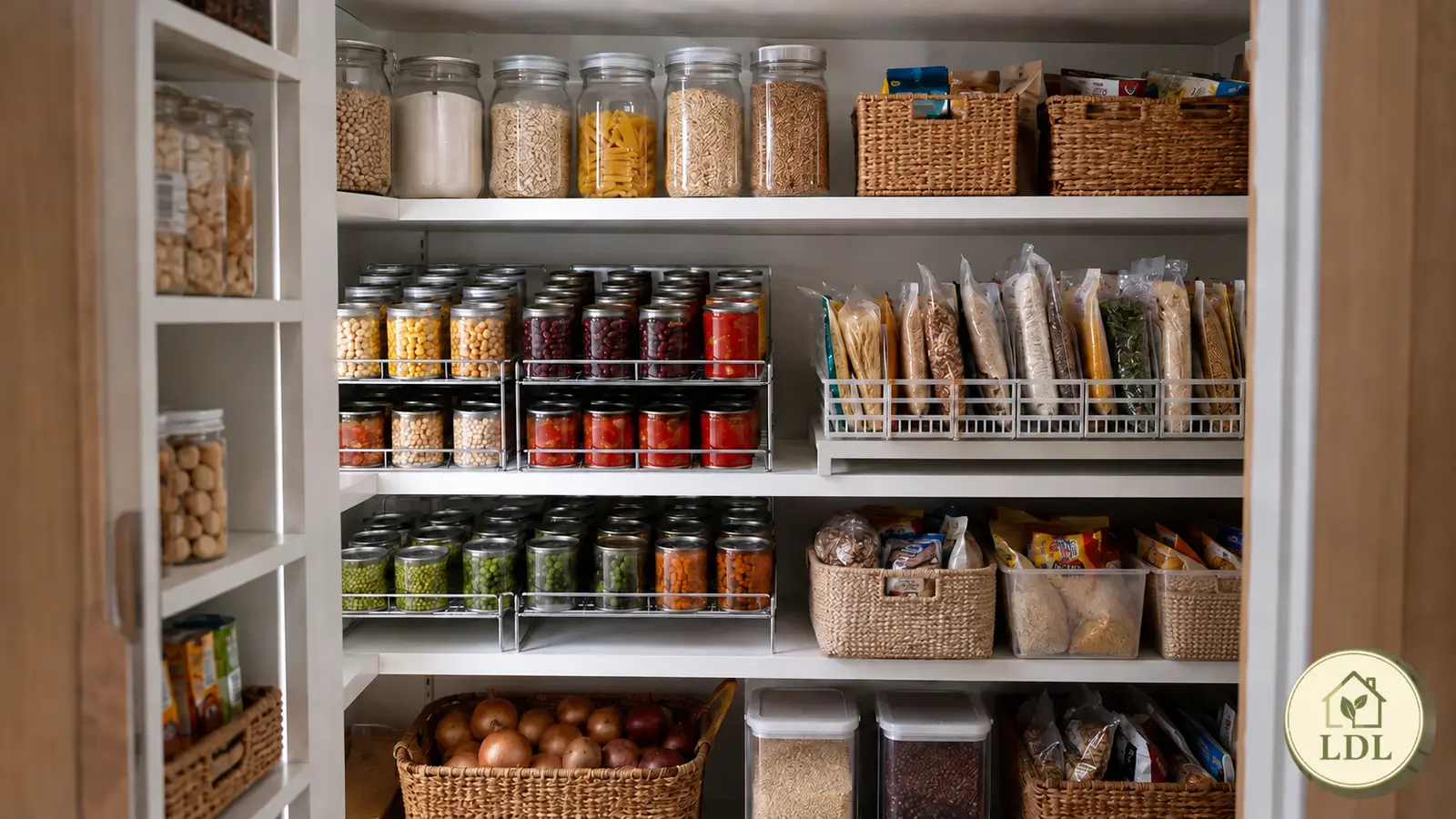
A small pantry can make you feel oddly defeated before you have even started cooking. You know the pasta is in there somewhere. The cereal box is leaning over a bag of flour. The soy sauce you use every other day is behind two bottles you bought for one recipe months ago. Then, while looking for something else, you find a second unopened jar of the exact thing you bought yesterday.
That kind of pantry is not difficult because you are bad at organizing. It is difficult because the easiest spaces have slowly filled with whatever arrived most recently, while the foods you reach for every day are competing with backups, occasional ingredients and awkward packaging.
The goal is not matching containers or perfectly lined shelves. The goal is much simpler: when you need breakfast, a snack or a dinner staple, your hand should know roughly where to go without a search party first.
1. Put everyday food in the easiest part of the pantry
One of the fastest ways to make a pantry feel better is also completely free: stop giving premium shelf space to food you rarely use.
Think about what your household reaches for on an ordinary week. Breakfast cereal. Rice. Pasta. Bread or wraps. School snacks. Tea or coffee. The oil or sauces you use constantly. Those are the foods that deserve the easiest shelf—not the unopened backup jar or the baking ingredient you use once every few months.
A useful rule is:
- eye and hand level: everyday food;
- lower or less convenient shelves: heavier items and backups;
- highest or deepest spaces: occasional ingredients and extras.
You are not organizing by importance. You are organizing by frequency. That small change reduces the number of things you have to move before getting to the thing you actually came for.
2. Create zones around real moments, not perfect categories
“Grains,” “condiments” and “dry goods” sound organized, but they are not always how a tired person thinks at 7:15 in the morning.
Sometimes it is easier to organize around the moment in which the food gets used:
- breakfast: cereal, oats, spreads and breakfast bars;
- grab-and-go snacks: crackers, pouches, nuts and lunchbox items;
- dinner basics: rice, pasta, canned foods and frequently used sauces;
- baking: flour, sugar, baking powder and decorations;
- backups: unopened extras that do not need to crowd the active shelf.
This matters especially when more than one person uses the pantry. If the system only makes sense to the person who created it, everybody else will slowly undo it. A “snacks” zone is easier to maintain than a complicated arrangement that requires remembering which shelf belongs to which packaging type.
3. Fix the back-of-the-shelf problem before adding more storage
Deep pantry shelves can look generous until you realize the front row has become a wall. You can technically fit more food behind it, but anything placed there becomes easy to forget.
First, try grouping similar bottles or jars on a tray you already own. Even a shallow baking tray can help because you can pull the group forward instead of reaching around individual bottles.
If the problem is mostly jars, sauces or small bottles, a rotating organizer can make the depth useful without requiring you to see over the front row. The LAMU 3-Pack Lazy Susan Organizer Turntables, for example, includes approximately 9.25-, 10.6- and 12-inch diameters. The idea is simple: instead of reaching behind the front row, you turn the tray until the back comes to you.
Think twice before buying one: a 12-inch turntable needs enough flat shelf depth and enough clearance to rotate without hitting the door, hinge or shelf lip. Tall, top-heavy bottles can also become less stable if the tray is spun quickly.
Read our guide to the LAMU turntable set →
4. Use the empty height above short food
Small pantries often waste space in a frustrating way: the shelf is tall, but the food sitting on it is short. A row of cans may only use half the vertical opening, while the shelf above is too far away to help.
Before buying a riser, see whether your pantry shelves can simply be adjusted. Moving a shelf down by a few inches may give you another usable level for free.
If the shelves are fixed, a riser can separate two layers without stacking cans, bowls or packets directly on top of one another. The Amazon Basics Stackable Metal Cabinet Organizer Shelves are listed at about 12.5 inches long × 8 inches deep × 4.5 inches high per shelf and can be used side-by-side or stacked.
The important question is not “Will this add storage?” It is “Will I still be able to see and reach what goes underneath it?” If the answer is no, the riser may simply create two cramped layers instead of one usable shelf.
Read our guide to the Amazon Basics shelf risers →
5. Do not decant everything just because matching containers look organized
Matching pantry containers can be genuinely helpful—but only when they solve something you already dislike.
They make the most sense when:
- bags repeatedly tear or collapse;
- you cannot tell how much is left;
- several foods come in awkward packages that will not stack;
- you buy the same staples often enough that transferring them is not extra work you will resent.
They make less sense when you are transferring twenty foods into containers simply because you think a pantry is supposed to look that way. Every extra step has to be repeated every time groceries come home.
The Vtopmart 24-Piece Airtight Food Storage Container Set is one large coordinated option. It includes 24 containers across four listed capacities—approximately 2.5 qt, 1.8 qt, 1.5 qt and 0.7 qt—with reusable labels.
That can work well if you genuinely want one system for many dry staples. But twenty-four containers are still twenty-four containers. If you only need flour, rice, cereal and pasta contained, starting with a smaller number may be easier to maintain and cheaper than reorganizing the entire pantry at once.
Think twice if: cabinet height is limited, you prefer glass, or the thought of decanting every grocery trip already feels like another chore. The current product title also states that the containers are dishwasher safe but the lids are not, so care instructions should be checked before washing.
Read our guide to the Vtopmart container set →
6. Label for memory, not decoration
A label is useful when it saves you from opening three containers or wondering whether something has been sitting there longer than you remember. It does not need to be beautiful to do its job.
You can use masking tape and a marker. You can write directly on a reusable container if that is allowed. Or, if your household changes contents often, removable labels can make the system easier to update.
The Hebayy removable food labels are blank 1 × 2-inch stickers supplied on a 1,000-label roll. That is far more than many homes need, so this is not automatically the sensible option just because the cost per label may be low.
A label system should reduce mental load. If maintaining it becomes its own hobby, simplify it.
Read our guide to the Hebayy removable labels →
7. Give cans and bottles a defined lane only if they keep rolling or spreading
Loose cans and bottles can consume more shelf space than expected because they spread sideways, hide one another and make it hard to use the space above them. But a dedicated organizer is only useful when you actually keep enough of that item to justify the footprint.
For canned drinks, the Sorbus Stackable Soda Can Organizer is listed at about 17.25 inches long × 5.6 inches wide × 5.9 inches high per organizer, with up to 12 cans in the intended format. Its flat lid is designed to make the space above the cans usable.
That sounds efficient until you put a 17.25-inch-long organizer into a pantry that is only 14 inches deep. Measure first. If your household only keeps four cans around at a time, a dedicated dispenser may also use more space than the cans themselves.
For reusable bottles or tumblers, the LANDNEOO 3-Tier Water Bottle Organizer stores bottles horizontally in 12 compartments in the selected configuration. The overall size is listed at about 17 × 7.8 × 10 inches. This is the kind of organizer that can solve a real problem if bottles are constantly falling over—but it needs meaningful shelf width.
8. Make one obvious home for open packages
Half-used packets are where a tidy pantry often starts falling apart. One bag of crackers gets folded and tucked beside the cereal. An open packet of pasta ends up behind the rice. A snack box has three pieces left but still takes up the footprint of a full box.
You do not need a special organizer for this. Use one basket, bin or shelf section you already own and make it the “open first” zone.
That creates a tiny bit of useful pressure: before opening a new packet, you can see what is already open. It also gives children or other family members one obvious place to return partially used snacks instead of choosing a new location every time.
9. Separate backups from active food
Buying extras can be practical. Storing the extra directly in front of the one you are using is usually not.
If you keep backups, give them a separate area—even if it is only the back half of one shelf or a lower basket. The active pantry should show what is currently in rotation. Backups should refill those spaces when needed.
This helps with one of the most annoying pantry experiences: buying something because you cannot see that you already have two more hiding behind other food.
You do not need a perfect inventory system. You just need your unopened extras to stop pretending they are everyday food.
10. Leave a little empty space on purpose
This is often the hardest part. An empty patch of shelf can look like wasted storage, especially when the pantry is small.
But a pantry filled to 100 percent capacity is difficult to use. There is nowhere to place a new grocery bag while you sort it. There is no room for a larger package than usual. Every item you remove has to be returned to exactly the right angle or the shelf stops working.
A little breathing room is functional storage. It lets the system absorb real life.
If you organize the pantry and every shelf is still packed edge-to-edge, the next question may not be which organizer to buy. It may be which foods no longer need to live there.
11. Do a five-minute reset before the pantry becomes a project again
The most useful pantry system is not the one that never gets messy. It is the one that takes five minutes to recover.
Once a week—or whenever groceries come home—do only four things:
- move open packages back to their zone;
- bring everyday foods forward;
- move backups out of the active shelf;
- notice anything you keep pushing aside and ask whether it still belongs there.
If your pantry requires a full Saturday afternoon every time it gets untidy, the system is probably too complicated.
Choosing containers? Glass vs Plastic Food Storage Containers: Which Is Better? →
A realistic 30-minute small-pantry reset
If the pantry is bothering you but you do not want to empty the whole thing, set a 30-minute timer and stop when it rings.
- Minutes 0–5: remove obvious rubbish, empty packaging and food you already know does not belong there.
- Minutes 5–10: pull everyday foods to the easiest shelf.
- Minutes 10–15: group breakfast, snacks, dinner basics and baking supplies.
- Minutes 15–20: move unopened backups away from the active zones.
- Minutes 20–25: create one open-package zone.
- Minutes 25–30: write down the one or two problems that remain—deep shelf, wasted height, falling packets, loose cans, unstable bottles.
Only after that last step should you consider an organizer. By then, you are shopping for a specific problem instead of hoping a product will organize the pantry for you.
Keep it simple
A small pantry feels easier when the system follows your habits
Put everyday food where your hand naturally reaches.
Group food by the moments your household actually uses it.
Use rotation or risers only when depth or wasted height is the real problem.
Decant only foods that genuinely benefit from it.
Keep open packages and backups from competing with active food.
The pantry does not need to stay picture-perfect. It just needs to make an ordinary breakfast or dinner require less searching, less moving and less remembering.
FAQ
Common questions about organizing a small pantry
Should I buy containers before organizing my pantry?
Usually not. First group the food you already own and identify the specific problems that remain. Containers are most useful when they solve collapsing packages, poor visibility, awkward shapes or a genuine need for stackable storage.
How do I organize a deep pantry shelf?
Keep frequently used items near the front and group small bottles or jars so the group can move together. A rotating tray can help when the shelf is deep enough for it; measure the usable shelf depth and door clearance before buying one.
What should go on the easiest pantry shelf?
The foods your household reaches for most often. Frequency is generally more useful than putting an occasional ingredient at eye level simply because it belongs to a particular category.
How do I stop buying duplicates?
Separate unopened backups from active food and keep frequently purchased staples visible. You do not need a detailed inventory if you can quickly see what is currently open and what is waiting as backup.
Are shelf risers worth it in a small pantry?
They can be useful when short items sit below a lot of unused vertical space. They are less helpful when the shelf is already shallow, when the items underneath become hard to reach, or when the available height is too low for two usable layers.
Your turn
What makes your small pantry difficult to use?
Tell us which foods disappear, overflow or become hard to reach on your shelves.
Comments are reviewed before anything is published. Your response will not appear publicly automatically.
If bread is one of the foods that keeps going stale or moldy before your household finishes it, our Bread Box vs Airtight Container guide helps you choose by bread type instead of buying another container by default.
Continue
Make the rest of the kitchen easier too
A note on this guide: Lighter Day Living has not personally tested the products mentioned in this guide. Product dimensions, capacities, materials and care details referenced here come from Amazon listing information reviewed for this guide on August 10, 2026. The organization advice is general and should be adapted to your own shelf dimensions and household habits. Product links in this article open Lighter Day Living product guides rather than Amazon directly. Each guide contains clearly labeled Amazon affiliate links. Verify current retailer details before purchasing.