
Decision guide
Glass vs Plastic Food Storage Containers: Which Is Better?
Glass avoids some of the everyday annoyances people associate with stained, smelly containers. Plastic is lighter, easier to carry and less stressful around drops. The better choice depends on what you actually store, heat and carry—not on declaring one material the winner for every kitchen.
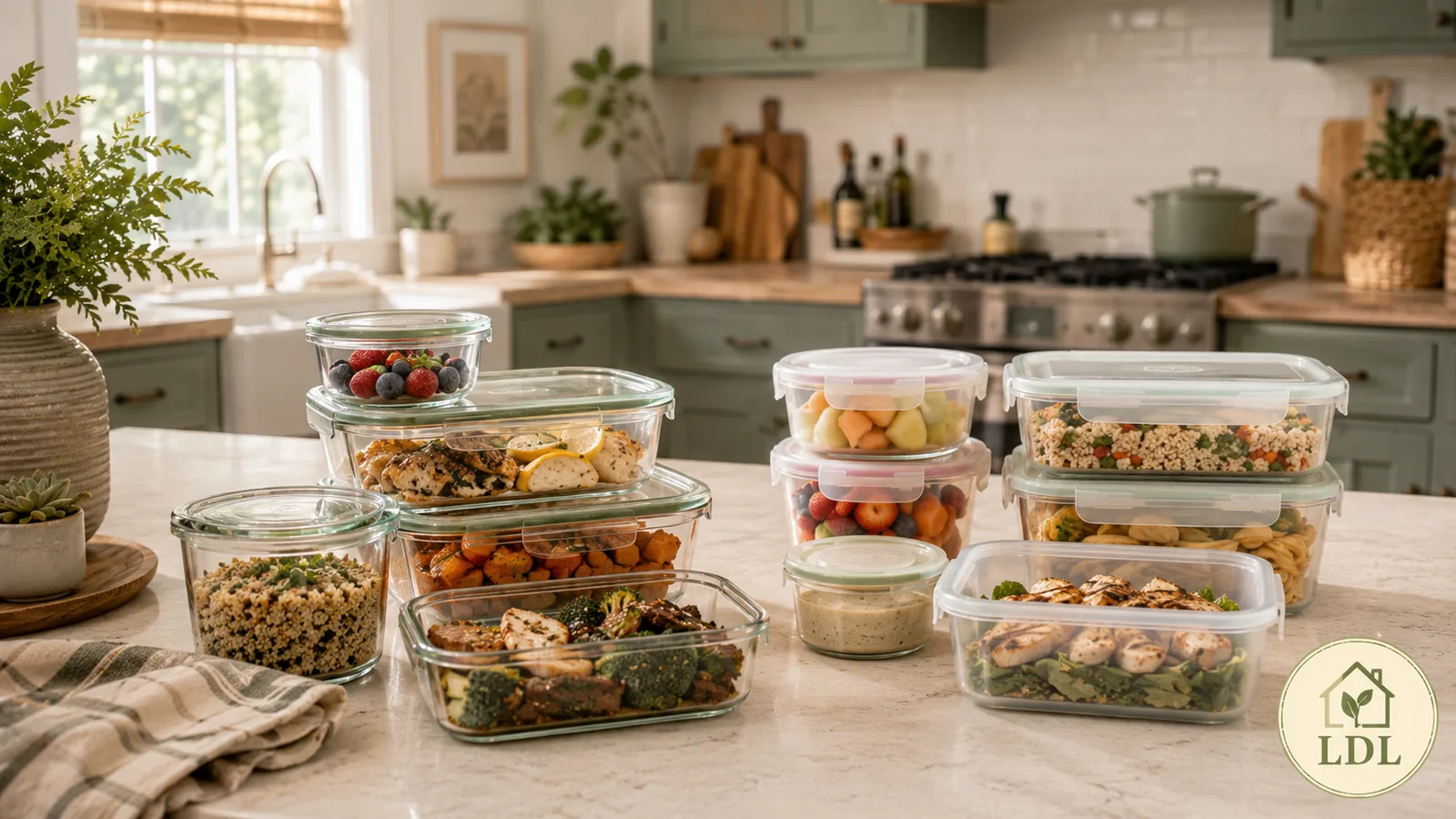
The argument usually starts after one small annoyance too many. A plastic container still smells faintly like last week's curry. A tomato-sauce stain refuses to leave. You think, “Fine, I should switch everything to glass.” Then you pick up a full glass lunch container, imagine carrying three of them to work—or watching one slide out of a child's hands—and suddenly plastic starts making sense again.
That is why this is not really a question of which material is “good” and which is “bad.” It is a question of which frustrations you are trying to stop. A container that feels perfect for reheating leftovers at home may be the one you hate carrying in a bag. A lightweight plastic set that makes packed lunches easier may not be the container you reach for when storing a deeply colored sauce.
The short version: glass and plastic solve different problems
Choose glass if you reheat leftovers often.
Heatproof glass that is specifically approved for microwave use can move from refrigerator to reheating with fewer questions about the container material. Always follow the manufacturer's instructions for the base and lid.
Choose plastic if you carry food around.
Plastic is generally lighter and more forgiving if dropped, which matters for work lunches, school bags, picnics and households where containers travel more than they sit in the refrigerator.
Choose glass if stains and lingering odors drive you crazy.
Glass is usually easier to keep looking and smelling neutral after strongly colored or aromatic foods.
Choose a mix if your kitchen does more than one job.
Glass for reheated leftovers and saucy foods; lighter plastic for packed lunches, dry pantry storage or situations where breakage would be inconvenient.
First: is glass actually “safer” than plastic?
This is where online comparisons often become too absolute. “Glass is safe; plastic is dangerous” is not a useful or well-supported rule.
The U.S. Food and Drug Administration regulates substances used in food-contact materials, including plastics. The FDA also states that current approved uses of BPA in food containers and packaging are considered safe. That does not mean every plastic container can be used for every purpose. The intended use of the specific container matters.
For microwaving, the USDA advises using cookware specifically manufactured and labeled for microwave use. It warns against heating food in one-time cold-storage containers such as margarine tubs, yogurt cartons and similar packaging because those containers are not designed for cooking.
So the practical safety rule is simpler than the internet debate:
- use food-storage containers for the uses they are designed for;
- only microwave a container when its current instructions say it is microwave-safe;
- follow the manufacturer's temperature guidance for both container and lid;
- replace damaged containers rather than trying to get “one more use” from badly cracked, warped or chipped pieces.
Official references: FDA guidance on BPA in food-contact applications ↗ and USDA microwave-container guidance ↗.
At a glance
Where each material usually feels easier
ReheatingGlass often feels simpler when the glass base is specifically rated for microwave use; plastic should only be heated when that particular container is labeled for it.
Stains & odorsGlass usually resists visible staining and lingering food smells better than plastic.
WeightPlastic is much easier to carry in lunch bags, backpacks and larger quantities.
Drop riskPlastic is generally more forgiving; glass can chip or break.
Pantry storageLightweight plastic can be practical for large dry-food sets; glass works too but becomes heavy when many containers are used together.
Best overall answerOften a small mixed system rather than choosing one material for every single job.
For reheating leftovers: glass usually has the cleaner use case
If your routine is “take leftovers from the fridge, heat them, eat them,” glass can remove one layer of hesitation—provided the exact glass container is approved for microwave use.
The BOROHOUSE 5-Pack Borosilicate Glass Meal Prep Containers is one example. The seller lists the borosilicate-glass bases for freezer, microwave and oven use, while giving separate temperature/use guidance for the lids. Each selected container is listed at 4.4 cups / 35.2 ounces.
The important part is not simply that it is glass. It is that the seller gives specific appliance-use instructions for this particular set. You should recheck those current instructions before heating because lids, seals and temperature limits can differ from the glass base.
Think twice if: you carry your meals every day. The package is listed at roughly 4.42 kg for the five-container set, so glass weight is not an imaginary drawback.
Read our guide to the BOROHOUSE glass container set →
Related: 1-Hour Meal Prep for Weeks When Dinner Feels Like Too Much →
For tomato sauce, curry and strongly colored food: glass is usually less annoying
You know the container is technically clean, but it still looks like the pasta sauce moved in permanently. That is one of the most emotionally persuasive arguments for glass because you see the evidence every time you open the cabinet.
Glass generally does a better job of staying visually neutral after strongly colored foods and is less likely to hold onto lingering food odors. That can make it feel cleaner over time even when both materials have been washed properly.
But this is a quality-of-life advantage, not a reason to throw away every plastic container you own. If your plastic containers mostly hold sandwiches, fruit, dry snacks or ingredients that do not stain them, you may not have this problem in the first place.
For packed lunches: plastic often wins before you leave the house
A glass container can feel perfectly reasonable sitting on a refrigerator shelf. It feels different when it is inside a bag with your laptop, water bottle, charger and everything else you are carrying.
Plastic's biggest everyday advantage is not glamorous: it is lighter. If you take several containers to work, pack lunches for children, carry snacks on outings or move food between homes, that difference becomes real very quickly.
Plastic is also less stressful around drops. That matters in households where a storage container is not treated like a piece of cookware but like something that gets pulled from a backpack, stacked in a sink and occasionally knocked onto the floor.
If portability is the main job, choosing heavier glass because it sounds more premium can create exactly the friction you were trying to remove.
For the freezer: the label matters more than the material name
Both glass and plastic containers can be designed for freezer storage. Neither material should be assumed freezer-safe just because another container made from the same broad material is.
With glass, breakage and thermal shock are the obvious concerns. Follow the manufacturer's temperature instructions and avoid treating every glass container as if it can move between extreme temperatures without consequence. With plastic, check that the specific container is intended for freezing and that the lid still seals properly after repeated use.
For leftovers generally, USDA guidance recommends cooling large amounts quickly in shallow containers, refrigerating promptly, and using most cooked refrigerated leftovers within three to four days. The storage material does not replace safe food handling.
Read USDA leftover-storage guidance ↗
For cabinet space: plastic can be easier—if the set actually nests well
Glass is not only heavier when full. A cabinet full of glass bases can become heavy and awkward even when they are empty. If you have a high shelf, narrow cabinet or a drawer that already struggles with lids, that matters.
Plastic containers can be lighter to lift and many sets are designed to nest. But do not assume “plastic” automatically means tidy. A badly designed plastic set can still create the famous lid avalanche every time you open the cabinet.
Before buying a set, look at how the empty containers store, not only how beautiful they look filled with food. The container spends far more of its life in your cabinet than it does posing in a product photo.
For dry pantry food: lightweight plastic makes a lot of practical sense
This is where glass-versus-plastic debates often ignore scale. A single glass leftovers container is one thing. Twenty-four large glass pantry containers filled with flour, pasta, rice, oats and cereal would be a very different storage system.
The Vtopmart 24-Piece Airtight Food Storage Container Set is plastic and designed for dry pantry ingredients rather than hot leftovers. It includes four container sizes with six of each size, plus reusable labels.
This is not a direct competitor to the BOROHOUSE leftovers set, and we do not want to pretend it is. It illustrates why material choice depends on the job. For a large dry-food system, lighter stackable plastic can be much easier to lift and rearrange than an equivalent amount of glass.
Think twice if: you only need a few containers. A 24-piece set can become its own storage problem if the pantry is small. The listing also states the lids are not dishwasher-safe.
Read our guide to the Vtopmart pantry container set →
Also useful: How to Organize a Small Pantry When You Can't Find Anything →
For cleaning: think about the lid as much as the container
Material gets all the attention, but lids are often the part people actually hate washing.
Snap locks, silicone gaskets, vents and deep grooves can hold moisture or food residue if they are not cleaned thoroughly. A simple glass base with a complicated lid can still be more annoying than a straightforward plastic container.
Before choosing a set, check:
- whether the base and lid are both dishwasher-safe;
- whether a gasket can be removed for cleaning;
- whether the lid has vents, valves or narrow grooves;
- whether the manufacturer gives different care instructions for lid and base.
This is one reason we keep product care notes in our guides rather than assuming “dishwasher-safe container” means every piece can go on every dishwasher rack.
For children and busy households: breakage changes the answer
If a container is going to be handled by a child, balanced on a stroller, pulled out of a crowded school bag or passed around during a family outing, the theoretical advantages of glass may matter less than the fact that it can break.
That does not mean children can never use glass food storage. It means the environment matters. At home on a refrigerator shelf, glass may be perfectly practical. In a backpack being thrown onto the floor, lightweight plastic may be the calmer choice.
This is exactly why a mixed cabinet often makes more sense than a material rule.
What about cost?
Plastic sets are often less expensive upfront, especially when you need many large containers. Glass can cost more and may feel like better long-term value if the containers stay clear, odor-neutral and intact for years.
But “glass lasts forever” is not a useful assumption either. A chipped or broken container is not long-term value. A plastic container that warps, stains badly or loses its lid is not good value just because it was cheap.
Instead of asking which material is cheaper, ask:
- How many containers do I actually need?
- How often will I carry them?
- How often will I heat food in them?
- Which foods repeatedly stain or smell in my current containers?
- Am I replacing a real problem or just replacing mismatched containers because a new set looks nicer?
The most practical answer for many homes: use both
You do not have to join Team Glass or Team Plastic.
A small mixed system can be much more logical:
- Glass: leftovers you routinely reheat, saucy foods, dishes that tend to stain containers, and food that mostly stays at home.
- Plastic: packed lunches, children's snacks, dry pantry ingredients, travel food and situations where low weight or drop resistance matters.
This also keeps you from buying twenty pieces in one material before you have learned whether you actually enjoy using them.
So, which is better: glass or plastic?
Glass is better when your main priorities are reheating convenience, resistance to stains and odors, and at-home leftovers.
Plastic is better when your priorities are low weight, portability, drop resistance and large-scale dry-food storage.
Neither material is automatically the “safer” choice in every situation. Use food-contact containers for their intended purpose, follow microwave/freezer/oven instructions for the specific product, and do not heat one-time cold-storage packaging as though it were reusable microwave cookware.
And if you have several different storage jobs—which most kitchens do—the best answer may be refusing to choose only one.
Decision shortcut
Choose by the frustration you want to stop
“I hate stained, smelly containers.” Start with glass for those foods.
“My lunch bag is already too heavy.” Keep lightweight plastic for transport.
“I reheat leftovers constantly.” Use containers explicitly rated for microwave use; heatproof glass is often a straightforward fit.
“I need a whole pantry system.” Consider the weight and scale before choosing glass for dozens of dry-food containers.
“I have kids and things get dropped.” Plastic may be the less stressful everyday option.
“I keep going back and forth.” You probably need a mixed system, not a winner.
FAQ
Common questions about glass and plastic food containers
Is glass food storage safer than plastic?
There is no useful blanket rule that glass is always safe and plastic is always unsafe. FDA regulates food-contact materials, and safe use depends on the specific product and how it is used. Follow the manufacturer's instructions, especially for heating. USDA advises microwaving food only in cookware manufactured and labeled for microwave use.
Is glass better for reheating leftovers?
Heatproof glass that is specifically approved for microwave use can be convenient because the same base can often move from refrigerator storage to reheating. Always check the current instructions for the base and lid because their temperature limits may differ.
Does plastic stain more than glass?
Plastic is more likely to show persistent stains from strongly colored foods such as tomato-based sauces, while glass generally stays visually neutral more easily. How noticeable that is depends on what you store.
Which is better for packed lunches?
Plastic is usually easier to carry because it is lighter and less vulnerable to breakage. Glass can still work for commuting, but the weight becomes noticeable when you carry multiple containers.
Can both glass and plastic containers go in the freezer?
Some can, but freezer suitability should be checked on the specific product. Follow the manufacturer's instructions rather than assuming that every glass or every plastic container has the same temperature tolerance.
Your turn
What matters most when you choose food-storage containers?
Tell us which tradeoff between reheating, weight, durability, staining and portability affects your routine.
Comments are reviewed before anything is published. Your response will not appear publicly automatically.
Continue
Make food storage easier to live with
A note on this guide: Lighter Day Living has not personally tested the products discussed in this comparison. Product-specific dimensions, materials, capacities and appliance/care statements come from Amazon listing information reviewed for this guide on August 10, 2026. General food-contact and microwave-safety guidance is based on FDA and USDA information linked above. We do not claim that one material is universally safer or healthier than another. Product links in this article open Lighter Day Living product guides rather than Amazon directly. Each guide contains clearly labeled Amazon affiliate links. Verify the current retailer listing and manufacturer instructions before heating, freezing, baking or washing any container.